Post-Nkomati Accord Challenges in Swaziland
On 19 April 1984, a combined Swazi Police and Army contingent went to a house in Manzini’s Old Ngwane Park, in Swaziland, where they experienced gunfire and grenades being directed at them from the house, to which they responded, and a shootout ensued. After a while, the Swazis took a decision to bomb the house in order to flush out the guerrillas, and the bomb ripped open a hole in the roof. Following this bombing, two heavily armed young men were killed. Sporadic fire continued throughout the evening, until approximately 22:00 at night. In the early hours of the morning, three guerrillas voluntarily gave themselves up, and the Swazi contingent got into the house, finding one of the guerrillas lying dead with his head blown off.
This exchange of fire between combatants of Umkhonto we Sizwe (MK) and the Swazi armed forces was a result of previous confrontations that were encouraged by the signing of the Nkomati Accord between Mozambique and apartheid South Africa on 16 March 1984. Following its signing, on 24 March, at least twelve homes of African National Congress (ANC) activists in Maputo were raided, including the residence of Joe Slovo, the then Chief of Staff of MK. According to ANC officials, four people were detained, weapons were confiscated, including Slovo’s handgun, as he was not at home at the time, busy appointing a “Co-ordinating Committee” that was tasked with overseeing ANC political and military work in Swaziland following the signing of the Accord.
The Committee’s chairperson was to be Ronnie Kasrils, its secretary and treasurer Ebrahim Ismail Ebrahim, both of whom were members of MK’s Natal structures during the Sabotage Campaign. Siphiwe Nyanda (aka “Gebhuza”) was to represent the Transvaal military structures on the committee, while the representative of the Natal military structures was to be Thami Zulu. Subsequent to the Committee meeting, Kasrils briefed Ismail Ebrahim that there was an existing threat of an imminent deportation of MK Cadres to Lusaka. During the first day of April, the exodus of MK combatants from Mozambique to Swaziland began in earnest, with the Commissioner of Police in Swaziland, Titus Msibi, mentioning that ten suspected ANC people were being held for questioning following a dawn raid in Mobeni Flats in Matsapa during the previous weekend.
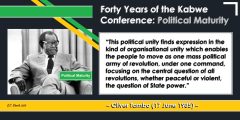
Out of ten people that were suggested by the ANC for its diplomatic mission in Mozambique, four were rejected, including Joe Slovo. Slovo, who was specifically asked by the Mozambican government to leave as he was regarded to be of such a high profile within the ANC. It was not a coincidence that he was elected as the first white member of the ANC’s National Executive Committee (NEC) at the Kabwe Conference in 1985. Only Jacob Zuma was ultimately accepted as Chief Representative in Maputo.
Following the signing of the Nkomati Accord, Maputo became virtually closed as a base for MK operations, thus making Swaziland to become the main housing facility for both the Natal and Transvaal MK urban and rural Machineries, especially for easy access to the industrial heartland in the Pretoria-Witwatersrand-Vereeniging (PWV) area. However, when Swaziland was exposed to had signed a similar agreement with the apartheid government in 1982, the MK command in the Kingdom panicked, and some of the cadres who were on their way to conduct operations inside the country, were infiltrated rapidly, without appropriate risk management.
The influx of MK Cadres from Mozambique made the April 1984 a month of confrontations between them and the Swaziland authorities. All along, Mozambique had been a secure base for MK, and every time they were in trouble in the Swazi Kingdom, they retreated to Mozambique. The trigger came on 10 April, when a group of at least fifteen ANC members that were captured near the Mozambican border, in Simunye, escaped. Following this escape, several incidents of shootouts with the Swazi security forces were reported, as guerrillas were arrested in groups, including Bafana Duma, an ANC Stalwart, who was arrested at his Swaziland home. Several AK-47 rifles, hand grenades and a variety of other explosives were confiscated. That evening, Capital Radio in the Transkei reported that Swaziland had ordered all ANC members out of the country.
On 11 April, a mixed group of thirty men from the Swaziland’s Special Branch and Police Mobile Unit headed to raid a house on the road leading to the golf course in Jubilee Village, approximately 1.6 kilometres from Mbabane’s Eveni suburb. At the targeted house, a group of men emerged wielding sub-machine guns, and a shootout with the police took place. Moments later, seven MK guerrillas surrendered to the Swazi police, coming out of the house with their hands raised. While they were surrendering, another group of eight rushed out of the house and dived into the river adjoining the Mbabane Golf Course. Swazi policemen gave chase but were unable to catch-up with the fugitives. It was later reported that scores of ANC members had been detained by Swazi security forces in an old army camp.
The following day, pedestrians came across a bullet-riddled corpse of a man on the side of the road between Sidvokodvo and Siphunga, in Swaziland. On 14 April 1984, the “Swaziland Observer” newspaper confirmed the body to be that of Zakhele Shongwe, a member of the ANC who was believed to have been killed during a shootout with the Swazi police on the night of 11 April. On the same day, 14 April 1984, Swazi police raided a house in Zakhele Township, in Manzini, where eleven MK guerrillas surrendered, while another twelfth guerrilla shot and killed a policeman at very close range. Similarly, in Mbabane’s Dalriach suburb, five guerrillas surrendered, and the Swazi police confiscated four AK-47 rifles, six hand grenades and a variety of other explosives.
All these confrontations with the Swazi authorities followed an incident at the peak of the morning rush hour, on 3 April 1984, at around 07:30, when a massive charge of TNT and plastic explosives concealed in the boot of an orange Datsun 120Y, parked near the dock entrance of Durban’s Victoria Embankment, close to Quayside Road, exploded. The vehicle was parked adjacent to an open ground on the bay side of the road, where there was a building of the Department of Home Affairs, next to the Customs and Excise House, as well as the apartheid South African Defence Force’s (SADF) Citizen Force’s navy headquarters in the vicinity.
Several civilians were injured and others died, and the blast opened a three-foot crater in the road, shattering windows of the Department of Home Affairs building. Shrapnel from the Datsun flew into a passing minibus, causing it to veer into the path of another vehicle, causing a crash that resulted in both drivers and passengers being injured. The car bomb marked a debut of the Natal Machinery’s Special Operations Unit after the signing of the Accord.
On 7 April 1984, MK Commissar Chris Hani, who was then in Maputo, wrote a letter to the Chief of Operations in Lusaka indicating that they might soon leave the area, and had to demonstrate that the Nkomati Accord did not destroy MK’s “capacity to act against the enemy both politically and militarily”.
Sources:
South African History Online (SAHO).
Ebrahim Ebrahim, “Beyond Fear: Reflections of a Freedom Fighter”, Jacana, 2022.
Mandla J. Radebe, “The Lost Prince of the ANC: The Life and Times of Jabulani Nobleman ‘Mzala’ Nxumalo”, Jacana, 2022.
Ronnie Kasrils and Fidelis Hove, “Comrade and Commander: The Life and Times of Joe Modise,” Jacana, 2024.
Stephen Ellis, “External Mission: The ANC in Exile”, Jonathan Ball, 2012.
Ronnie Kasrils, “international Brigade Against Apartheid: Secrets of the People’s War that Liberated South Africa”, Jacana, 2021.
Vladimir Shubin, “ANC: A View from Moscow”, Jacana, 2008.
Janet Smith and Beauregard Tromp, “Hani: A Life Too Short”, Jonathan Ball, 2009.
Castro Khwela
Good evening fellow Compatriots!
Discover more from CASTRO KHWELA
Subscribe to get the latest posts sent to your email.