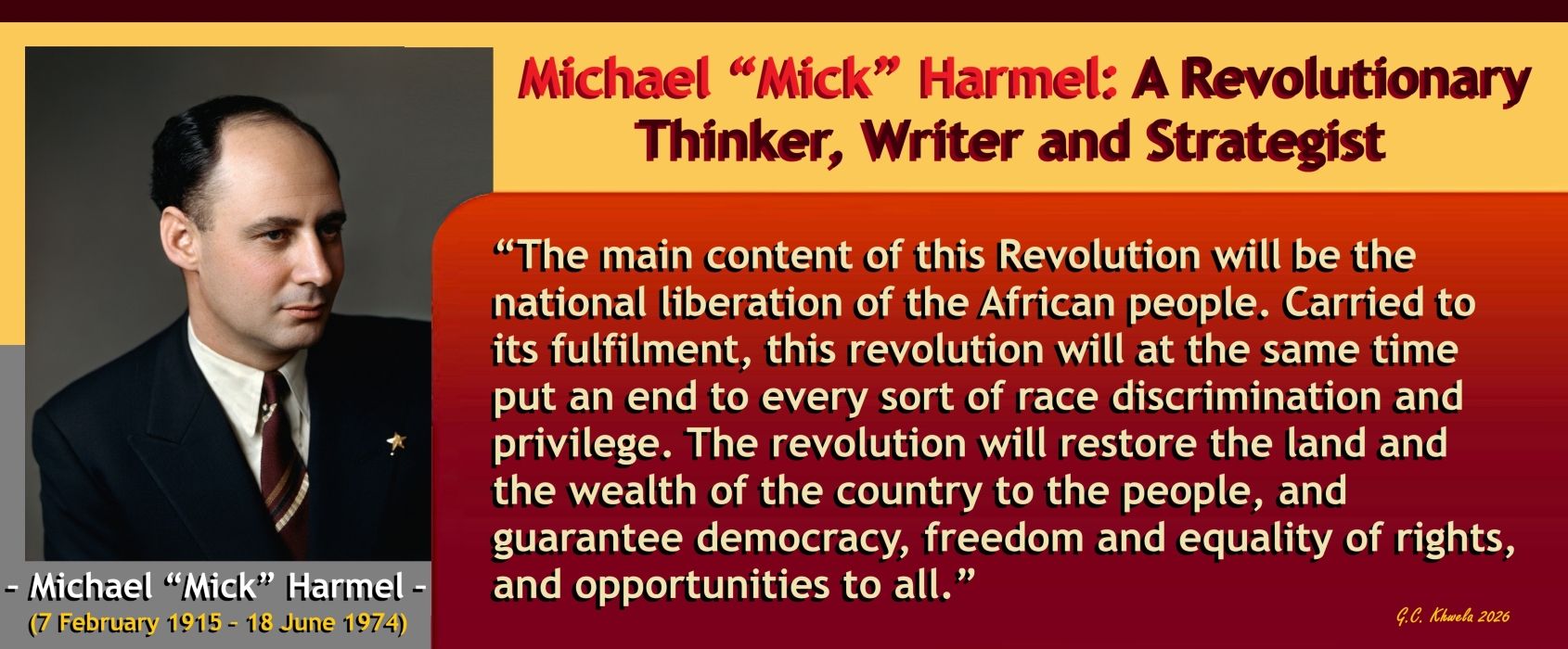
Michael “Mick” Harmel: A Revolutionary Thinker, Writer and Strategist
On 18 June 1974, a revolutionary South African anti-imperialist activist, journalist and South African Communist Party (SACP) member Michael “Mick” Harmel died in Prague, in the then Czechoslovakia, while he was working for the “World Marxist Review” journal. Known by his pen name “A. Lerumo”, he was a founding member of the SACP, after the Communist Party of South Africa (CPSA) was banned, and a key historical figure in the country’s liberation struggle.
Michael “Mick” Alan Harmel was a prominent South African anti-colonialist and anti-imperialist activist, journalist, and intellectual who served as the leading theoretician of the South African Communist Party (SACP). He was born in Doornfontein, Johannesburg, on 7 February 1915, and grew up in Johannesburg, where he later became a close political ally and friend of Nelson Mandela. His father was Arthur Aaron Harmel (born 1884), an Irish-born socialist of Russian-Jewish descent, who trained as a pharmacist in Dublin before emigrating to South Africa in 1910. He was highly anti-imperialist and deeply influenced Michael’s early political worldview.
His mother, Sarah Landau, belonged to the Irish-Jewish community and was born to Polish-Jewish parents. She married Arthur in Bulawayo, Southern Rhodesia (now Zimbabwe), but tragically died of the Spanish flu in 1918, when Michael was only three years old. Michael was raised primarily by his father following his mother’s early death, and he grew up in the vibrant immigrant and working-class environments of Johannesburg.
Influenced heavily by his father’s anti-imperialist teachings, he completed his early schooling there before moving to the Eastern Cape to attend Rhodes University during the 1930s. It was during his university student days that he became firmly attracted to Marxism and radical socialism, returning to Johannesburg in 1939 to officially join the Communist Party and dedicate his adult life to full-time revolutionary work.
Harmel married Ray Adler in 1940, a fellow activist, who had emigrated to South Africa from Lithuania, with whom he had a daughter, Barbara. The couple separated in the mid-1960s, whilst living in exile in London. Before leaving the country for exile, the family lived in Yeoville, Johannesburg, before building a family home in 1954 in The Gardens, a small northern of Johannesburg. Their home became a place of welcome and refuge for key political figures being pursued by the apartheid police, such as Nelson Mandela, Winnie Madikizela Mandela, Walter Sisulu, Ahmed Kathrada, Bram Fischer, Sheila Weinberg and others.
Michael “Mick” Alan Harmel stood out from other revolutionaries of his time because he was the chief ideological architect and leading theoretician of the South African liberation movement. While others were primarily known as military commanders, mass mobilisers, organisers or legal minds, Harmel’s unique impact came from shaping the literal vocabulary, strategy and intellectual framework of the anti-apartheid struggle. Harmel’s most enduring legacy was developing the seminal concept of “Colonialism of a Special Type”. Adopted into the South African Communist Party’s (SACP) official programme in 1962, “The Road to South African Freedom”, this theory brilliantly resolved a massive ideological dilemma for the left.
Harmel argued that South Africa was unique; it was a country where the coloniser (the white minority) and the colonised (the Black majority) coexisted within the exact same geographic borders. This intellectual framework gave the SACP and the African National Congress (ANC) a shared, robust justification for prioritising the national democratic revolution, overthrowing racial apartheid and implementing the Freedom Charter, as the essential first step towards achieving a socialist state. In this way, Harmel played a foundational role in forging the structural and conceptual bonds of the Tripartite Alliance.
Unlike traditional Western communists who often kept a distance from nationalist movements, Harmel used his intellectual influence to integrate class struggle seamlessly with the national liberation struggle. He was highly trusted by nationalist leaders, even working in secret at the famous Liliesleaf Farm alongside Nelson Mandela, who explicitly praised Harmel as a “brilliant theorist” who provided the quiet and vital blueprint for their policy matters. While many revolutionaries focused on direct physical resistance, Harmel’s weapon was his pen. He served as the founding editor of The African Communist in 1959, an illegal journal that smuggled radical ideas across Africa and the world.
Writing largely under his pseudonym, A. Lerumo, he authored “Fifty Fighting Years”, the definitive translated history of the SACP’s struggle. Through editing the journal Liberation in the 1950s, he opened up a platform that crossed racial lines, publishing pivotal early essays by emerging leaders like Govan Mbeki and Nelson Mandela, thereby steering public debate during the drafting of the Freedom Charter. Despite his academic and writing disposition, Harmel was not an “armchair revolutionary”. He balanced intense intellectual work with high-stakes operational danger.
During the turbulent 1950s, Harmel shifted his resistance into a dual existence: orchestrating a highly illegal underground network while simultaneously utilising public, lawful structures to build a cross-racial united front against the apartheid state. His roles across these specific milestones were foundational to the survival and expansion of the liberation movement. After the introduction of the Suppression of Communism Act of 1950, which formally outlawed the Communist Party of South Africa (CPSA), the majority of the leadership voted to dissolve the party to protect members from immediate imprisonment. Harmel was one of only two Central Committee members who fiercely opposed self-dissolution.
Undeterred by the ban, Harmel worked tirelessly alongside a small, dedicated collective to secretly reconstitute the movement under illegal, underground conditions. This clandestine network officially reemerged in 1953 as the South African Communist Party (SACP). In 1952, Harmel became one of the very first white activists served with statutory banning orders under the Act. He intentionally and repeatedly defied these restrictions, resulting in a continuous cycle of police arrests and harsher, renewed banning orders throughout the decade.
During the Defiance Campaign of 1952 – a mass civil disobedience movement spearheaded by the ANC and South African Indian Congress (SAIC) – Harmel’s role was defined by behind-the-scenes coordination and media warfare. Because he was banned from attending public gatherings, Harmel weaponised the progressive press. He served as a crucial writer and correspondent for The Guardian newspaper and its subsequent iterations like Spark and New Age, which were continually banned and had to be renamed to bypass the apartheid state. He used these platforms to publish vital updates, maintain morale and articulate the political strategy to avert or combat mass arrests.
Because the SACP was illegal and the ANC was constitutionally a Black-only organisation at the time, there was a desperate need for a vehicle to mobilise progressive white South Africans. Subsequently, in 1953, Harmel became a founder member of the South African Congress of Democrats (COD) alongside key allies like Bram Fischer, Ruth First and Joe Slovo. Harmel used the COD to officially draw radical white allies into the Congress Alliance – a formal non-racial coalition led by the ANC. He aggressively expanded the COD’s reach by engaging white trade unionists, liberals and university students.
He argued passionately that white South Africans had a moral and political duty to actively follow African leadership in the broader liberation struggle rather than acting as paternalistic commentators. The climax of the Congress Alliance’s non-racial mobilisations was the Congress of the People, which was held in Kliptown on 26 June 1955, where the historic Freedom Charter was adopted. Operating completely under heavy state surveillance and strict banning orders, Harmel was a core illegal architect and planner of the gathering. He attended secret, late-night planning committees to structure how ordinary citizens across South Africa would submit their demands for a free country.
As the editor of the influential journal, Liberation, during this period, Harmel effectively used its pages to orchestrate the intellectual debates leading up to the Congress of the People. He opened the publication to prominent thinkers like Nelson Mandela and Govan Mbeki, allowing them to debate and refine the core socio-economic principles that ultimately shaped the text of the Freedom Charter. He practiced his egalitarian beliefs openly, serving as the Headmaster of the Central Indian High School – the first school in South Africa with a fully non-racial teaching staff – where he personally mentored future liberation icons like Essop and Aziz Pahad.
Ultimately, while others executed the revolution on the ground, Mick Harmel was the man who gave the revolution its mind, writing the maps that guided the liberation movement through its darkest decades. When the movement turned to armed struggle, Harmel was appointed directly to the High Command of Umkhonto we Sizwe (MK), proving he was willing to back his revolutionary theory with armed conflict. Within the National High Command of MK, Harmel did not act as a tactical combat commander but served as its Commissar: foremost political-military theoretician, propaganda director and key operational strategist.
His specific contributions within the High Command included the ideological blueprint for the armed struggle. Harmel’s most critical role was providing the intellectual justification for the transition from non-violence to sabotage and armed conflict. Writing heavily in MK publications and the SACP organs like The African Communist, Harmel fiercely argued against the traditional Marxist view of waiting passively for conditions to be “ripe for insurrection”. Drawing directly from the successful guerrilla strategies of the Cuban Revolution and the Algerian War of Independence, he argued that initiating a disciplined, armed people’s force could actively help create the conditions for a broader national uprising.
As a High Command member, Harmel was part of the inner circle that met secretly at Liliesleaf Farm in Rivonia, Johannesburg – the underground headquarters of the liberation movement. He participated in the high-stakes, late-night planning sessions that approved MK’s early sabotage campaigns targeting infrastructure, power stations and government property and drafting the Umkhonto we Sizwe (MK) Manifesto. The High Command viewed armed action as ineffective without political direction and education.
Harmel was tasked with leading the propaganda apparatus, ensuring that every act of sabotage was clearly explained to the public to prevent it from being viewed as random terrorism. He drafted the underground literature, political manifestos and educational booklets smuggled to cadres and new recruits to align MK’s military objectives with the overarching political goals of the national democratic revolution. In July 1963, South African apartheid police raided Liliesleaf Farm, arresting the core leadership of the MK High Command. Because Harmel had not been at the farm during the exact moment of the raid, he evaded immediate capture. However, state prosecutors identified him as a major co-conspirator in the historic Rivonia Trial (1963–1964).
Recognising that he was a prime target for execution or life imprisonment, the SACP Central Committee ordered Harmel to slip out of the country into exile. From abroad, he continued to direct the political education of MK forces training across Africa and Europe. When the Party ordered Harmel into exile in London in 1963, his operational role shifted from domestic underground organising to international diplomacy, media warfare and global anti-apartheid mobilisation. During his 11 years in exile, Harmel acted as the primary bridge between the liberation movement and the international community through several key roles.
Harmel’s primary directive from the SACP in exile was to continue editing and producing The African Communist, the party’s ideological publication. Operating from London, he oversaw its printing and distribution network, transforming it into a highly influential quarterly journal. It served as a critical intellectual lifeline, keeping exiled cadres, international socialist allies and hidden underground networks in South Africa theoretically aligned on the strategy of the liberation movement.
To mark the 50th anniversary of the SACP in 1971, the Party’s Central Committee commissioned Harmel to document its complete history. Writing under his long-time underground pseudonym, A. Lerumo, he authored “Fifty Fighting Years”. The book became a massive success within international left-wing circles and was translated into multiple languages, providing a formal narrative that legitimised the SACP and the ANC’s combined struggle to a global audience.
Harmel also utilised his personal heritage and European location to build structural international resistance against the Pretoria regime. He worked directly out of the ANC’s London offices, playing an influential role in expanding the reach, strategy and boycotts organised by the British Anti-Apartheid Movement. Drawing on his father’s deep Dublin roots, he became instrumental in helping to establish the Irish Anti-Apartheid Movement (IAAM). This helped cultivate a highly fierce base of political and economic solidarity against apartheid within Western Europe.
Harmel acted as a crucial diplomat, frequently travelling to conferences, international summits and state meetings across Africa, Asia and Western Europe. He leveraged these platforms to secure critical financial backing, educational scholarships and military resources from Eastern Bloc and socialist nations to sustain Umkhonto we Sizwe (MK) forces’ training in exile. In 1972, the SACP seconded Harmel to Prague, Czechoslovakia, to serve as the Party’s official representative on the editorial board of the “World Marxist Review”. This was a highly prestigious posting within the international communist movement, giving South Africa’s liberation struggle a permanent, prominent platform at the heart of global socialist media.
Harmel remained dedicated to this diplomatic and editorial work in Prague until he passed away from illness on 18 June 1974, where he was buried with full revolutionary honours by his international and South African comrades. At his funeral in Prague, on 24 June 1974, the Chairman of the SACP, Dr Yusuf M. Dadoo said, “We have come together to pay homage to Comrade Michael Harmel, an outstanding South African revolutionary whose whole life was unconditionally and totally dedicated to the struggle of the people and who devoted all his adult years to the cause which was dear to him above all others: the cause of liberation, socialism and internationalism.”
“Comrade Harmel was a man whom nature had endowed with considerable talents as a thinker, writer and publicist. He used these gifts unselfishly to enrich a movement and a struggle towards whose growth and development he made a lasting contribution.”
Sources:
Wikipedia.
South African History Online (SAHO).
Yusuf M. Dadoo, “Obituary: Michael “Mick” Harmel”, Sechaba, Vol. 8, No.s 10-11-12, October-November-December 1974.
Editorial Notes, “Death of Michael Harmel”, The African Communist, No. 59 Fourth Quarter 1974.
Yusuf M. Dadoo, “An Outstanding Revolutionary: Oration by Dr. Yusuf M. Dadoo, Chairman of SACP, at the funeral of Michael Harmel in Prague, June 24, 1974”, The African Communist, No. 59 Fourth Quarter 1974.
Vladimir Shubin, “The Birth of Umkhonto we Sizwe: Old and New Sources”, New Contree: (Institute for African Studies, Russian Academy of Sciences), Vol. 42, 29 November 1997.
Sheridan Johns, “Invisible Resurrection: The Recreation of a Communist Party in South Africa in the 1950’s”, African Studies Quarterly, Vol. 9, Issue 4, Fall 2007.
SA Presidency, “The Order of Luthuli in Silver: Michael Alan Harmel (Posthumous)”, The Presidency South Africa, Chancellor of the National Orders, 22 April 2013.
Simon Stevens, “The Turn to Sabotage by The Congress Movement in South Africa”, Past & Present, Vol. 245, Issue 1, November 2019.
Maurice J Casey, “The Irishman Who Fought with Mandela for Freedom”, The Irish Times, 11 January 2022.
Gary Snapper, “The Harmel Family”, http://www.gabrielsnapper.co.uk/harmel.html
Eddy Maloka, “Remembering Michael Harmel, One of South Africa’s Great Progressive Theorists”, Daily Maverick, 21 January 2025.
Castro Khwela
Good morning fellow Compatriots!🙏🏾✊🏾👊🏾
Discover more from CASTRO KHWELA
Subscribe to get the latest posts sent to your email.