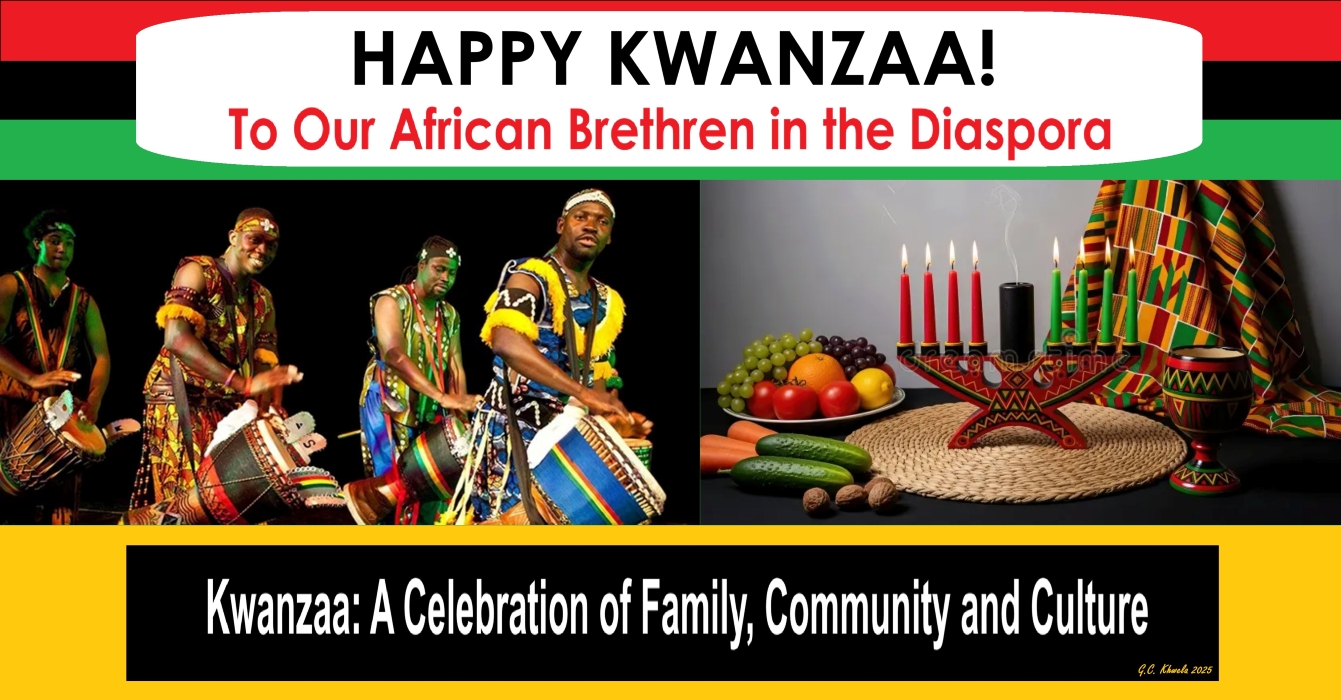
HAPPY KWANZAA! TO OUR AFRICAN BRETHREN IN THE DIASPORA
Kwanzaa is a time of learning, family and celebration.
During the week of Kwanzaa, from 26 December to 1 January, families and communities come together to share a feast, to honor the ancestors, affirm the bonds between them, and to celebrate African and African American culture.
Kwanzaa is not a religion. Perhaps, one of its most significant features is that it facilitates unity amongst all Africans in the diaspora regardless of their religion. Kwanzaa may be celebrated by any African, especially those in the diaspora, of any religion, or of no religion.
The name Kwanzaa derives from the Swahili phrase “matunda ya kwanza”, meaning “first fruits”. First fruits festivals exist in Southern Africa and are celebrated in December/January with the southern solstice. The Kwanzaa celebration was partly inspired by the Zulu festival “Umkhosi Wokweshwama” (First fruits festival) or “Umkhosi Woselwa” (the Calabash festival).
Kwanzaa celebrates what its founder, Maulana Karenga, called the seven principles of Kwanzaa, or “Nguzo Saba” (originally “Nguzu Saba” – the seven principles of African Heritage). They were developed in 1965, a year before Kwanzaa itself. These seven principles are all Swahili words and together comprise the “Kawaida” or “common” philosophy, a synthesis of African nationalism, pan-Africanism and socialist values.
Each of the seven days of Kwanzaa is dedicated to one of the principles, as follows:
- “Umoja” (Unity): To strive for and to maintain unity in the family, community, nation, and race.
- “Kujichagulia” (Self-determination): Self-definition and naming, as well as to create and speak according to self.
- “Ujima” (Collective work and responsibility): To build and maintain community together and make African brothers’ and sisters’ problems common problems and to solve them together.
- “Ujamaa” (Cooperative economics): To build and maintain own stores, shops, and other businesses and to profit from them together.
- “Nia” (Purpose): To make collective vocation the building and developing of community in order to restore the people to their traditional greatness.
- “Kuumba” (Creativity): To do always as much as one can, in the way they can, in order to leave the community more beautiful and beneficial than it was inherited.
- “Imani” (Faith): To believe with all their hearts in the people, parents, teachers, leaders, and the righteousness and victory of the African revolutionary struggle.
Source:
Wikipedia.
Maulana Karenga, “Kwanzaa: A Celebration of Family, Community and Culture”, University of Sankore Press, 1997.
Castro Khwela
Good day fellow Compatriots!🙏🏾✊🏾👊🏾
Discover more from CASTRO KHWELA
Subscribe to get the latest posts sent to your email.