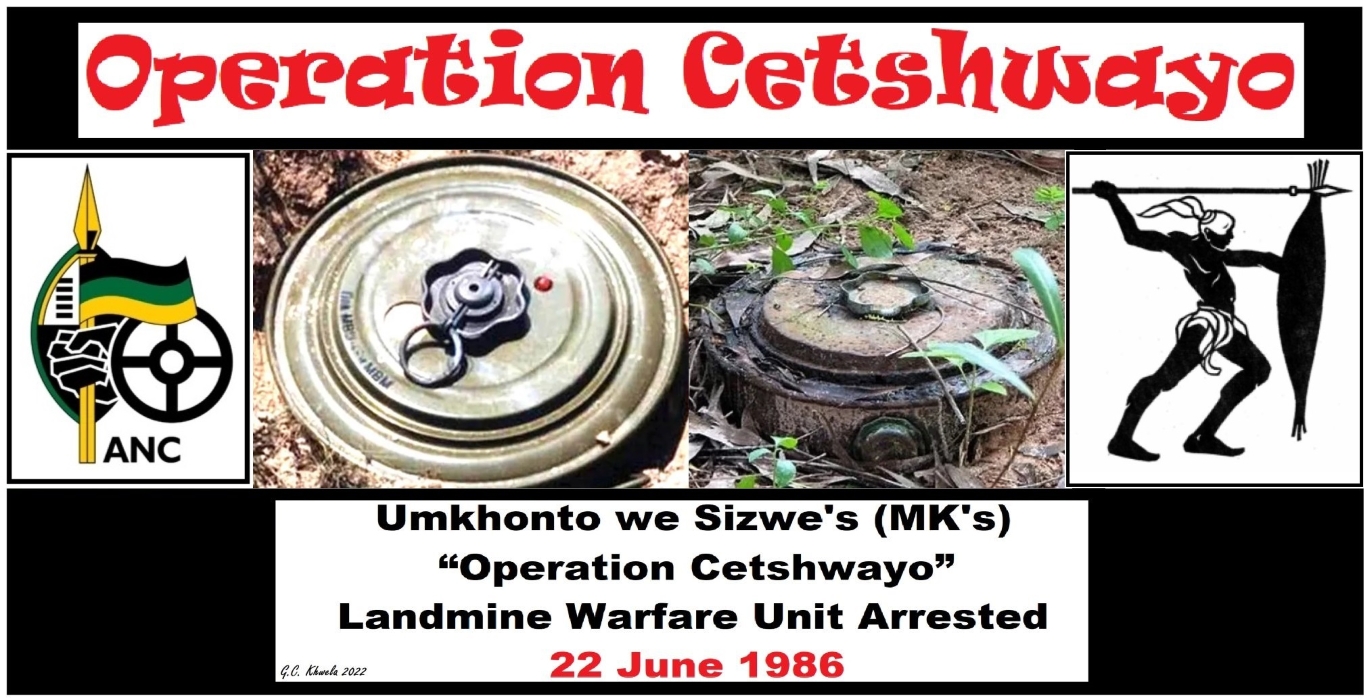
MK “Operation Cetshwayo” Landmine Warfare Unit Arrested
On the evening of 22 June 1986, Simon Dladla was driving a green BMW registered SD 026 to Swaziland from Johannesburg, with Acton Mandla Maseko and two other Umkhonto we Sizwe (MK) cadres. Ominously, the vehicle was stopped at a roadblock in Edenvale, and the police constable who arrived at the car noticed a strange-looking object in Maseko’s overalls. When the police officer demanded to search Maseko, he refused and a struggle ensued, resulting in a hand-grenade and a Makarov pistol being found in his possession. All the four combatants were then arrested.
On 8 June 1986, Dladla and Maseko entered South Africa in a beige Datsun registered SD 314. Two days later, they planted a mine on the dirt road near Bloemhof farm in the Volksrust district, in the perimeter between south-east of the Transvaal and north-western Natal. They then returned to Swaziland to report to the Transvaal Implementation Machinery. On that morning, at approximately 07:20, eighteen-year old Martin Coetzer was on his way to school in a bakkie when, about a metre from the gate to his parent’s farm, there was an explosion under the vehicle. He was thrown in the air by the impact, with both his legs, his right arm and his jaw were broken, and he also suffered a skull fracture. On the same day, at about 10:15, a farmworker, Elias Shabangu, who was aged twenty-three, and Lucas Lushaba, who was twenty-five, were driving a tractor on a dirt road on another plot in the area when they detonated a landmine, causing them chest and leg injuries.
On 21 April 1986, around 08:00 in the morning, on a dirt road between the towns of Chrissiesmeer and Breyten, about 176 kilometres east of Johannesburg, Ben Ndluli was driving a taxi with two passengers inside when an explosion suddenly occurred under the vehicle. Ndluli was badly lacerated and Jan Moshuloane, one of the passengers, had part of his leg blown away. Approximately three hours later at the farm Vlakfontein, a few kilometres from the scene of the first incident, Simon Mkhwanazi was driving a tractor, about hundred metres from a farmhouse, when the tractor detonated a landmine. Mkhwanazi received injuries to his right leg, face and eye. Two passengers who were in an attached trailer, Piet Sibanyoni and his son, Stoel Sibanyoni, were seriously injured.
All these landmine operations occurring since the commencement of 1985, were part of the programme to destabilise South Africa’s border regions, which had its origins at the Kabwe conference. The intention was to create conditions allowing guerillas to traverse, and survive in, these areas. After the conference, MK formulated a plan to use landmines to denude the border areas of white farmers. Attacks against white farmers were deemed justifiable because of their role in state border defence networks. It was a role the government also recognised and valued.
In the beginning of April 1986, landmine operations were coordinated by the Transvaal Implementation Machinery of MK, which met in Swaziland. This Machinery was a structure to coordinate the activities of the African National Congress’ (ANC) political and military, rural and urban structures for the Transvaal. In attendance were Paul Dikeledi, who was the Head of the Machinery, Vusimuzi Sindane, Acton Mandla Maseko and Glory Sedibe (aka “September”). The meeting was arranged because Dikeledi had received orders from ANC Headquarters, in Lusaka, that the Swaziland Regional Politico-Military Committee (RPMC) and the Transvaal and Natal Implementation Machineries, had to commence with landmine warfare. Following this meeting, Acton Mandla Maseko met Simon Dladla and told him to identify potential targets for mine warfare on white farms in the eastern Transvaal. Dladla and Maseko then entered South Africa shortly afterwards to reconnoitre the Breyten and Volksrust areas.
A landmine is an explosive device that is often concealed under or camouflaged on the ground, which is designed to destroy or disable enemy targets as they pass over or near it. Land mines are divided into two types: anti-tank mines that are designed to disable tanks or other vehicles; and anti-personnel mines that are made to injure or kill human beings. Land mines are typically pressure activated, exploding automatically when stepped on by a person or driven over by a vehicle, though alternative detonation mechanisms are sometimes used. A land mine may cause damage by direct blast effect, by fragments that are thrown by the blast, or by both. Land mines are typically laid throughout an area, creating a minefield that is dangerous to cross.
The controversy in the use of land mines is because of their indiscriminate nature and their potential to remain dangerous many years after a conflict has ended, harming civilians, livestock and the economy. Pressure groups emerged in the post-Second World War period to campaign against the use of landmines that resulted in the International Campaign to Ban Landmines, a global movement to prohibit their use. The efforts of this campaign led to the 1997 Convention on the Prohibition of the Use, Stockpiling, Production and Transfer of Anti-Personnel Mines and on their Destruction, also known as the Ottawa Treaty. The treaty was signed by 164 nations to date, with China, the Russian Federation and the United States refusing to become signatories.
Although landmines are largely used in conventional warfare to destroy or disable enemy vehicles and personnel during massive conflicts, they were commonly deployed by guerrilla forces to destabilise well-organised forces during a guerrilla war. In the wars against the colonial forces in southern Africa, such as the war of independence in Namibia, the People’s Army of Namibia (PLAN), the armed wing of the South West African People’s Organisation (SWAPO), guerrillas used anti-tank mines to throw the apartheid South African military convoys into disarray before attacking them.
To discourage detection and removal efforts, they also laid anti-personnel mines directly parallel to the anti-tank mines. This initially resulted in heavy South African military and police casualties, as the vast distances of road network vulnerable to guerrilla sappers every day made comprehensive detection and clearance efforts impractical. The only other viable option for the apartheid South African Defence Force (SADF) was the adoption of mine-protected vehicles which could remain mobile on the roads with little risk to their passengers even if a mine was detonated. The South Africa defence industry was widely credited with inventing the v-hull, a vee-shaped hull for armoured vehicles, which deflected mine blasts away from the passenger compartment.
With regard to guerrilla mine warfare in South Africa, dubbed “Operation Cetshwayo”, it must be emphasised that Umkhonto we Sizwe (MK) never used anti-personnel mines, specifically because the ANC was concerned to avoid civilian casualties. The ANC only advocated for the utilisation of anti-tank mines, which required at least 300kg to detonate, because the primary targets were the military patrols on roads immediately next to borders. The mines were laid overnight so that they would be triggered when the apartheid SADF patrolled early the following morning. It was reasoned that because farmworkers generally did not have transport and moved around on foot, they were unlikely to be affected.
While regretting all loss of life, the ANC noted that the apartheid regime had declared white border farms military zones, with white farmers integrated into the security system and provided with the tools of war, including automatic weapons. Regarding the ANC’s limited use of landmines, beginning in late 1985, MK operatives were under strict instructions to carry out reconnaissance properly so that military patrols were the primary targets of landmine operations. In the border areas, where nearly all landmines were detonated, the precise targeting of military patrols was easier said than done.
Nevertheless, Umkhonto we Sizwe MHQ continued to stress policy regarding careful reconnaissance and avoidance of civilian targets, although white farmers in these areas were not defined as civilians even by the apartheid state itself: they were its first line of defence. The ANC maintained that the use of landmines on white border farms was justified because the apartheid regime had declared them military zones, with white farmers integrated into the security system and provided with the tools of war including automatic weapons, which were only legally possessed by members of the apartheid armed forces.
The ANC did not have reliable statistics on how many people were killed during the implementation of “Operation Cetshwayo”, in landmine explosions for which the MK was responsible. A rough estimate based on available press reports revealed that approximately thirty explosions took place between November 1985 and July 1987 resulting in about 23 deaths in total, including two cadres who were killed whilst laying a mine.
The decision to activate “Operation Cetshwayo”, which related to the use landmines and the choice of area of operation was made at Umkhonto we Sizwe Military HQ. Th responsible commands were based in Zimbabwe and later, for operations in the Eastern Transvaal, in Swaziland. Units were sent into the country to conduct reconnaissance with the aim or determining the movements of enemy personnel on the roads, their routines and schedules, the habits of local people, etc. This usually took a few days, and once the reconnaissance was completed, cadres reported back to their commanders. Operational plans were drawn up, and the reports and plans were then sent to MK MHQ for approval. When operations were approved, detailed implementation plans were drawn up and cadres were instructed to lay the mines.
Initial operations were carried out fairly close to the borders, approximately 2 – 4 km from the border fence. However, ANC President and MK Commander-in-Chief, OR Tambo, ordered that operations should be carried out deeper inside the country as the governments of neighbouring countries were coming under pressure from the apartheid regime. The governments that came under a lot of pressure because of the landmine explosions were Swaziland, Zimbabwe and Botswana, where “Operation Cetshwayo” was more effective, especially in the Transvaal province.
The effect of this was to move some operations into areas where the roads were not used almost exclusively by the apartheid SADF and Commando farmers, but also by civilian vehicles. In addition, because cadres had to be in the country longer there was an increase in the number of firefights between guerrillas and the security forces. Ultimately, when it became apparent that the landmine operations were not having the desired effect of consistently striking at security forces, they were suspended by Umkhonto MHQ.
Sources:
Wikipedia.
South African History Online (SAHO).
African National Congress, “Statement to the Truth and Reconciliation Commission”, August 1996.
African National Congress, “Further Submissions and Responses by the African National Congress to Questions Raised by the Commission for Truth and Reconciliation”, 12 May 1997.
Howard Barrell, “Conscripts to Their Age: African National Congress Operational Strategy, 1976 – 1986”, D. Phil: Oxford University, 1993.
Joe Slovo, “1976 to the Present”, Dawn, Souvenir Issue, 1986.
Truth and Reconciliation Commission, “Truth and Reconciliation Commission of South Africa Report”, Vol. 2, 29 October 1998.
Truth and Reconciliation Commission, “Truth and Reconciliation Commission of South Africa Report”, Vol. 6, 21 March 2003.
Thula Simpson, “Umkhonto we Sizwe: The ANC’s Armed Struggle”, Penguin, 2016.
Castro Khwela
Good evening fellow Compatriots!
Discover more from CASTRO KHWELA
Subscribe to get the latest posts sent to your email.