Oliver Tambo Meets with British Foreign Office Minister Lynda Chalker
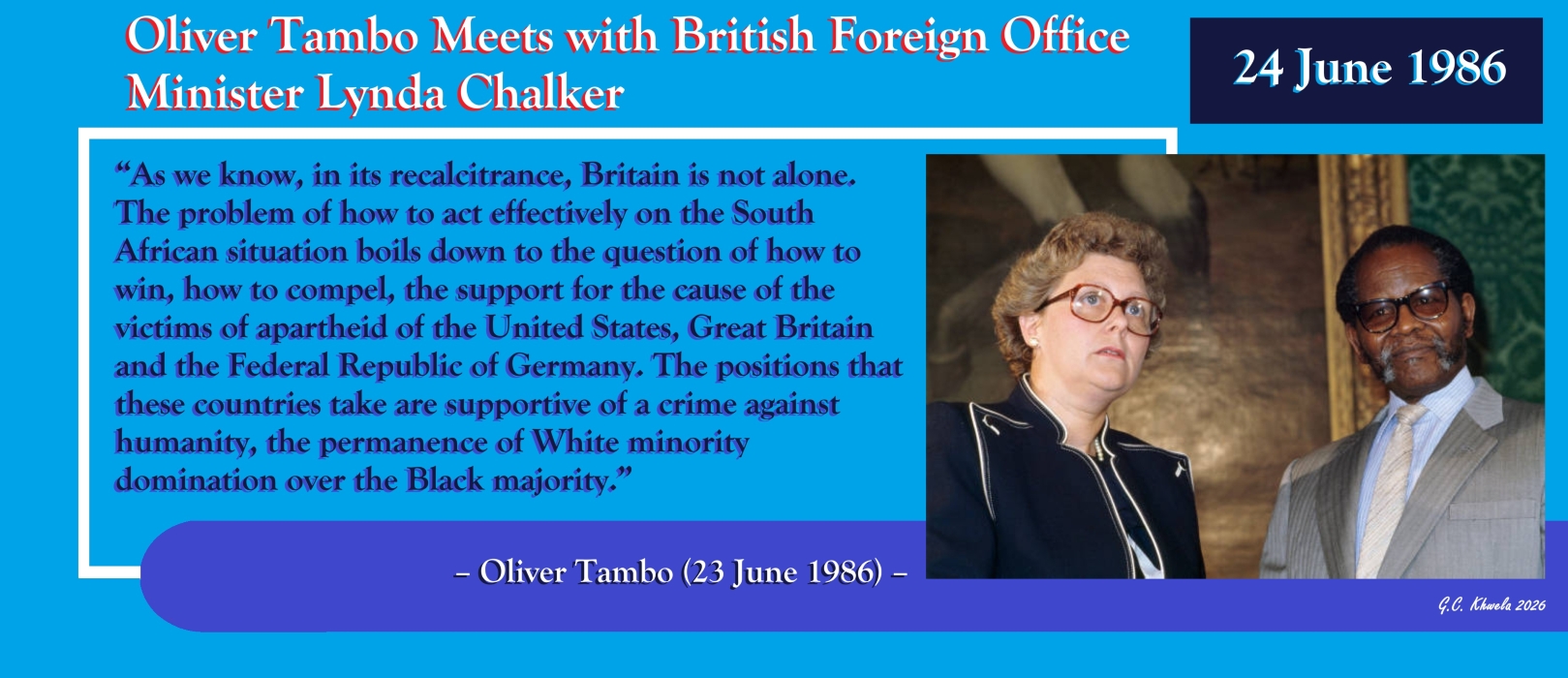
On this day, 24 June 1986, the then President of the African National Congress (ANC), Oliver Reginald Tambo, met with Great Britain’s Foreign Office Minister, Lynda Chalker, for the first time in a quest to end apartheid. President Tambo’s meeting with Minister Chalker was viewed as a turning point in British Government policy toward the ANC, which was outlawed in South Africa. The Thatcher Government previously had refused to meet with ANC leaders unless the movement renounced violence.
Tambo described the 75-minute meeting as “cordial and candid”, but said he had been given no hint of a change in Britain’s position, as Foreign Minister Chalker emphasised on the need to suspend the use of violence as an important step towards attaining a peaceful change in South Africa. The meeting was described by President Tambo as useful, “We got the views of the British government; the ANC got its own views across”, he said. “One doesn’t expect to meet a Foreign Office minister and begin immediately to expect a shift of positions”.
While Tambo said that he was unable to budge Britain from its opposition to comprehensive economic sanctions against South Africa during his talks with the Foreign Minister and had given no promise to give up the ANC’s guerrilla campaign, he said that they both had expressed the hope for what he called “further opportunities for discussion of these matters”.
Meanwhile, Minister Chalker told reporters that “there was a good deal more understanding than I feared there might be”, since the significance of the meeting was not so much its content but that it took place at all. “We have had a very serious and useful meeting”, Chalker said. “We were very honest and strong and candid with one another but we left the meeting shaking hands, talking about the future”.
A Foreign Office spokesperson said, “This meeting may lead to further high-level talks”, further adding that, “It is the first time we have had such a meeting with Mr Tambo. It is significant and we are glad he accepted the invitation to meet Mrs Chalker.” According to the Foreign Office officials, the British Government’s Overseas and Defence Committee had a meeting at 10 Downing Street the same day to consider possible economic sanctions against South Africa and to make recommendations to a full Cabinet meeting the following day.
Prime Minister Margaret Thatcher maintained her position, however, in Parliament the same day arguing that general economic sanctions would not help end South Africa’s crisis. Thatcher contended that “In the end, there will have to be negotiations between the Government and black South Africa and we should keep our eye on that purpose and do everything possible to achieve it”. Although Thatcher explained to the House of Commons that Chalker was meeting Tambo to persuade him to give up violence as a means to end the system of apartheid, the move was widely interpreted as a signal to the South African government that it must do more to bring about change.
The meeting also was likely intended to ease pressure on Britain from the other nations of the Commonwealth, where it was virtually isolated in opposing broad sanctions. If anything, the British government’s opposition to sanctions was even stronger than that of the United States Ronald Reagan Administration’s. Despite rising public outrage at South Africa, as evidenced by consistently large demonstrations in London, Prime Minister Margaret Thatcher claimed that such measures would be as ineffectual as those taken in the 1960s and 1970s against the white Ian Smith’s UDI government in Rhodesia.
She believed that they would hurt black South Africans, not to mention the independent black states to the north of South Africa, long before they would have any real impact on apartheid. Essentially, Thatcher was concerned about Britain’s estimated $8 billion direct investment in South Africa, the largest of any nation, and the possible loss of 120 000 British jobs in the United Kingdom if total economic sanctions were adopted.
The Thatcher government also faced a meeting of the Commonwealth on 2 August 1986, at which Britain was likely to find itself being a minority of one on the subject of sanctions. In May 1986, after a visit to South Africa, some members of the Commonwealth’s Eminent Persons Group (EPG) declared that the worsening situation made sanctions a necessity. At least one Commonwealth leader, Zambian President Kenneth Kaunda, had threatened to pull his country out of the Commonwealth unless Britain adopted a firmer policy on the South African issue. So the British government took the “symbolic step” of inviting President OR Tambo, leader of the African National Congress (ANC), to meet with Lynda Chalker, a Minister of State in the Foreign Office.
Britain found a willing ally in West Germany, another of South Africa’s leading commercial partners, since Bonn (West German capital) consistently opposed trade sanctions, as counterproductive, and considered them pointless without the cooperation of the United States and Japan. Nevertheless, several of the smaller powers, including the Netherlands, Denmark and Ireland, called in vain for the European Economic Commission (EEC) to take stronger action against the apartheid regime in South Africa.
Most of the arguments against sanctions were based on apartheid South Africa’s relative strength. The country produced much of what it needed, including armaments, nuclear power and more than 50 percent of its oil through a coal-liquefaction process. Three of its leading exports – gold, platinum and diamonds – were rare and easy to sell. Others, such as chromium and manganese, were in high demand for strategic reasons.
In his address to the Royal Commonwealth Society, in London, the day prior to the meeting with Foreign Minister Chalker, President Tambo stated, “As we know, in its recalcitrance, Britain is not alone. The problem of how to act effectively on the South African situation boils down to the question of how to win, how to compel, the support for the cause of the victims of apartheid of the United States, Great Britain and the Federal Republic of Germany. The positions that these countries take are supportive of a crime against humanity, the permanence of White minority domination over the Black majority.”
Tambo further declared that “The death that we suffer in the course of struggle is a sacrifice we are ready to make. We ask for no pity. We ask for support from those who, we believe, in our position would feel compelled to do what we are doing to seek to end the pain of apartheid.” Earlier that day, 24 June 1986, before the meeting with Minister Chalker, Tambo met with a group of Conservative members of Parliament where he refused to renounce the use of “necklace” killings, in which tyres were placed around a victim’s neck and set on fire. Tambo maintained that “The necklace is a product of apartheid”, and “I regret it but I cannot condemn it”.
Nevertheless, the meeting on 24 June 1986 between Oliver Tambo and British Foreign Office Minister Lynda Chalker had a profound and lasting political and diplomatic impact on the international struggle against apartheid. While the content of the dialogue focused heavily on Britain urging the ANC to suspend its armed struggle and pursue peaceful change, the true impact lay in the symbolism and the shifting geopolitics of the era. Prior to this event, Prime Minister Margaret Thatcher’s Conservative government consistently refused formal high-level engagements with the ANC, categorising it as a terrorist organisation due to its violent tactics. This meeting represented an official U-turn and a major diplomatic breakthrough, demonstrating that the British government could no longer ignore the ANC as the primary voice of South Africa’s black majority.
By hosting Oliver Tambo, Great Britain effectively dealt a massive psychological blow to the Pretoria regime. The South African government relied heavily on Western institutional backing. This meeting served notice that Western powers were actively building bridges with the national liberation movement, progressively choking the international credibility and isolation of the apartheid government. The meeting elevated Tambo’s stature and that of the ANC’s external mission. It paved the way for subsequent high-profile engagements with global leaders and corporate giants.
Accompanying Tambo were key officials Thabo Mbeki and Aziz Pahad, who used these platforms to sharpen their diplomatic skills. This helped establish the ANC internationally not just as a resistance group, but as a sophisticated government-in-waiting ready for statehood transition. The open communication channel helped lower structural hostilities. It served as a precursor to the confidential, behind-the-scenes talks hosted in Britain between Afrikaner intellectuals, businessmen and the ANC. These combined engagements ultimately created a precious basis of trust that laid the groundwork for the formal, peaceful democratic negotiations of the early 1990s.
Sources:
Wikipedia.
South African History Online (SAHO).
Tyler Marshall, “Britain Shifts Stand, Agrees to Meeting with Tambo”, Los Angeles Times, 23 June 1986.
Los Angeles Times, “Tambo Meets Briton: More Talks Hinted”, Los Angeles Times, 24 June 1986.
L.A. Times Archives, “London Opens Talks with Tambo”, Los Angeles Times, 24 June 1986.
Frank J. Prial, “British Official Meets South African Rebel Leader”, The New York Times, 25 June 1986.
William E. Smith, “South Africa the Debate Over Sanctions”, TIME Magazine, 7 July 1986.
Sarah Benton, “The Apartheid Effect: Britain and South Africa”, Marxism Today, August 1986.
LaVerle Berry, et. al., “Significant Political-Military Developments in Sub-Saharan Africa”, A Report Prepared under an Interagency Agreement by the Federal Research Division, Library of Congress, October 1984 – September 1986.
Victor Moukambi, “Relations Between South Africa and France with Special Reference to Military Matters, 1960-1990”, Doctor of Philosophy: Stellenbosch University, December 2008.
Christabel Gurney, “Interview with Baroness Lynda Chalker”, Anti-Apartheid Movement Archives, 31 March 2014.
Oliver Tambo, “We Have Decided to Liberate Our Country and Ourselves”, Sechaba, August 1986.
Castro Khwela
Good morning fellow Compatriots!🙏🏾✊🏾👊🏾
Discover more from CASTRO KHWELA
Subscribe to get the latest posts sent to your email.