The Golela Episode
On 20 April 1993, a strictly confidential report undersigned by the then Umkhonto we Sizwe (MK) Chief of Staff, Siphiwe Nyanda (aka “Gebhuza”) was uncovered, which was presented on 2 March 1993 by the African National Congress (ANC) and titled “Brief Summary of Findings of Inquiry into Golela Incident”.
The report was based on interviews conducted as part of an internal investigation with the persons arrested in connection with the Golela Incident. The inquiry unearthed evidence of systematic arms smuggling implicating senior leaders of the movement. The document noted that it became clear from the interviews that at least five trips had been undertaken to Maputo to smuggle weapons into the country. This was referring to the link between the Southern Natal Command of Umkhonto we Sizwe (MK) and Bafana Cyril Dlamini (aka “Edwin Ndlovu”), MK’s Ordinance Chief in the Mozambican capital. The numbers suggested that MK Comrades had relied on a good infrastructure and had access to resources.
It all began in February 1992, when Jeff Radebe, the ANC Southern Natal Chairperson, briefed Chris Hani about the conflict with Inkatha in his region. Hani advised him to get involved in the establishment of self-defence units (SDUs) in his area. In March 1992, Jeff Radebe approached “Edwin” Dlamini and raised the hardware requirements of the ANC in southern Natal. Following the meeting between Jeff and Edwin, the latter met Aboobaker Ismail (aka “Rashid”), who was at the time the overall head of MK’s Ordnance Department.
After being briefed by Edwin about the request from southern Natal for arms, Rashid responded by saying that nothing was needed inside South Africa, since they had all the materials they needed. He also reminded Edwin that Joe Modise had instructed that no arms were to be brought into the country in violation of agreements reached with the apartheid government. Despite Rashid’s objections, which, as he said, were based on commitments given by the ANC, most explicitly in the D.F. Malan Accord, the project of smuggling arms from abroad into Natal’s southern regions proceeded without hindrance.
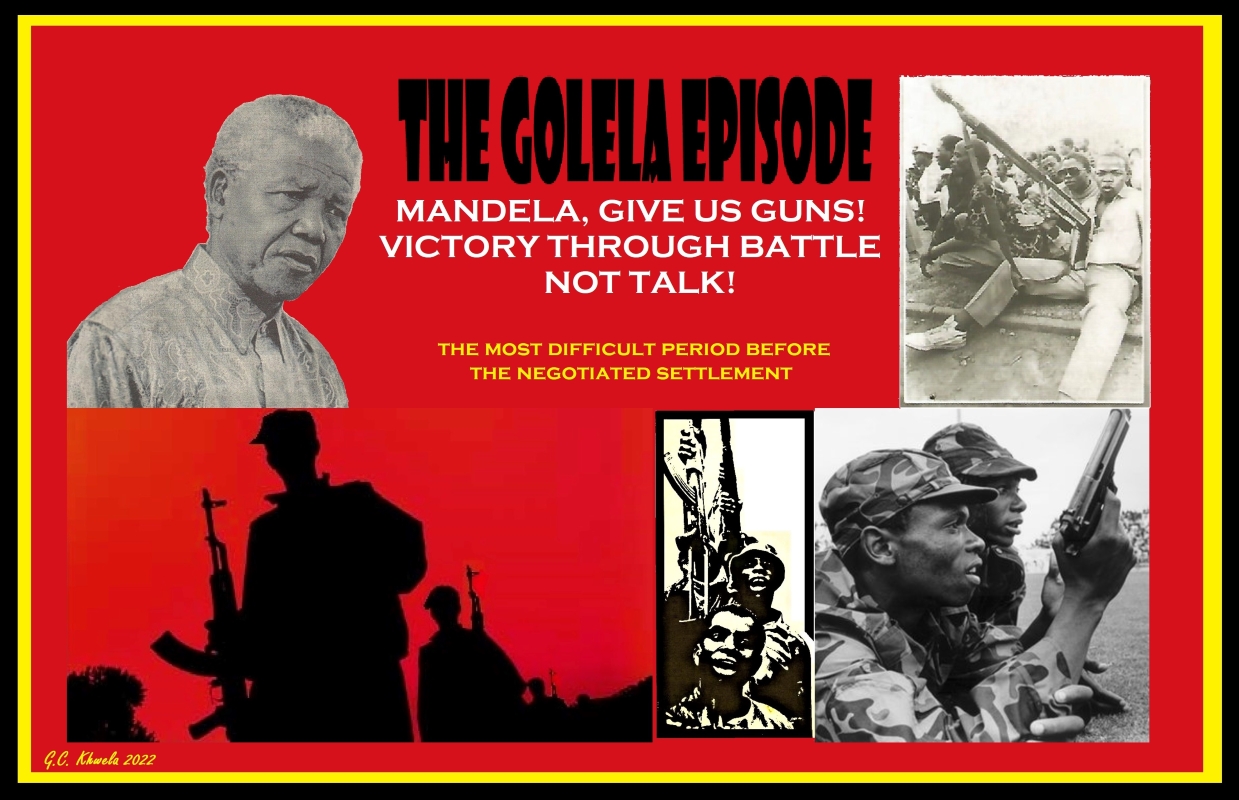
At an ANC rally of about twenty thousand people in the Vaal, following the Boipatong Massacre, on 17 June 1992, whereby forty-six people, consisting largely of women and children, were brutally killed by a heavily armed force of Inkatha members, ANC President Nelson Mandela saw signs that read, “MANDELA, GIVE US GUNS” and “VICTORY THROUGH BATTLE NOT TALKS”. It became clear to Mandela that people were frustrated, as they could not see any positive results from the negotiations. People were beginning to think that the only way to overthrow the apartheid regime was through the barrel of a gun. According to Mandela, some members of the National Executive Committee (NEC) of the ANC began asking questions of “Why did we abandon the armed struggle? We should abandon negotiations instead; they will never advance us to our goal.”
Towards the end of March, Jeff Radebe and Sipho Sithole (aka “Mandla”), met Edwin Dlamini and Vusumuzi Derrick Ngobese (aka “Mavivi”) in a Durban office, where Jeff introduced the two to Edwin, and he responded that he knew them both from exile. Edwin was part of the MK Luthuli Detachment which was involved in battles against Rhodesian and South African security forces in the Wankie and Sipolilo Campaigns in 1967 and 1968. After the clashes, Dlamini crossed to Botswana where he was arrested after attempting to cross to South Africa. After his release in Botswana Dlamini moved to Mozambique in 1975 where he was involved in the receiving and inducting scores of young people who left the country after the 1976 Soweto Uprisings. He subsequently participated in the MK machinery that infiltrated armaments into South Africa between 1977 and 1990.
On 1 February 1993, at around 17:00, a car registered RBM533T passed through the Golela border post with two men inside, Mandlenkosi Clifford Makhoba and Derrick “Mavivi” Ngobese. A uniformed border policeman asked the driver to open the boot. When the policemen rummaged through the items, and lifted the mat, they found a panel plate, which they forcefully opened with crowbars. Under the panel, were 13 Stechkin 9×18-mm pistols with 26 magazines; 9 Makarov 9×18-mm pistols with 18 magazines; two RPG-7 rocket launchers; six PG 7 rockets; six PG primary loads; 31 F1 hand grenades; 40 UZRG detonators for hand grenades; and 2 800 AK-47 bullets.
The policemen then told Ngobese and Makhoba they were under arrest and were taken to a room in the station to be interrogated. On 3 February 1993, at about 14:00, Sipho Sithole, was at the ANC office in Durban’s Umngeni Road when the phone rang, and when he picked it up, a voice on the other side of the line shouted “Mandla!”, as the police stormed the room, handcuffed him and left the office with him. Sipho “Mandla” Sithole, had been a member of the ANC and MK since 1982, where he received basic military training in Angola, received specialised training in East Germany, in 1986 and other training in 1987 to 1988 in the Soviet Union. Mandla had been an MK Commander between the years 1984 and 1991, the MK Chief of Staff in the Southern Natal region between the years 1991 and 1994 and an ANC Regional Executive Committee (REC) member from 1992 – 1993 for Southern Natal.
During this period, Natal became a killing-ground. Heavily armed Inkatha supporters had in effect declared war on ANC strongholds in the Natal Province, where entire villages were set alight, dozens of people were killed, hundreds were wounded and thousands became internal refugees. According to the then ANC President Nelson Mandela, “As the violence continued to spiral, I began to have second thoughts about the suspension of the armed struggle. Many of the people in the ANC were restive, and …at a press conference, I said that the continuing violence might necessitate taking up arms once more. The situation looked very grim, and any understanding that had been achieved with the government seemed lost.”
The Golela Report, which was presented by Siphiwe “Gebhuza” Nyanda, concluded that the numbers of weapons that were smuggled into the country suggested “that the comrades relied on a good infrastructure and had access to resources. They therefore could not have been acting on their own. The movement has denied the involvement by its top structures. We therefore must treat this report with the utmost confidentiality and circumspection because it has serious implications if it is handled otherwise.”
Sources:
Wikipedia.
South African History Online (SAHO).
Truth and Reconciliation Commission (TRC), “Amnesty Hearing: Establishment of SDU’s”, Amnesty Committee of the Truth and Reconciliation Commission, 1 December 1998.
Padraig O’Malley, “Chapter Eight: Destabilising the Opposition in 1994” in Padraig O’Malley, “The Heart of Hope: South Africa’s Transition from Apartheid to Democracy”, The Nelson Mandela Foundation, 2009.
Mercury Reporter, “Former MK cadre dies at 75”, Natal Mercury, 22 September 2011.
Nelson Mandela, “Long Walk to Freedom”, Abacus, 1994.
Thula Simpson, “Umkhonto we Sizwe: The ANC’s Armed Struggle”, Penguin, 2016.
Castro Khwela
Good day fellow Compatriots!
Discover more from CASTRO KHWELA
Subscribe to get the latest posts sent to your email.