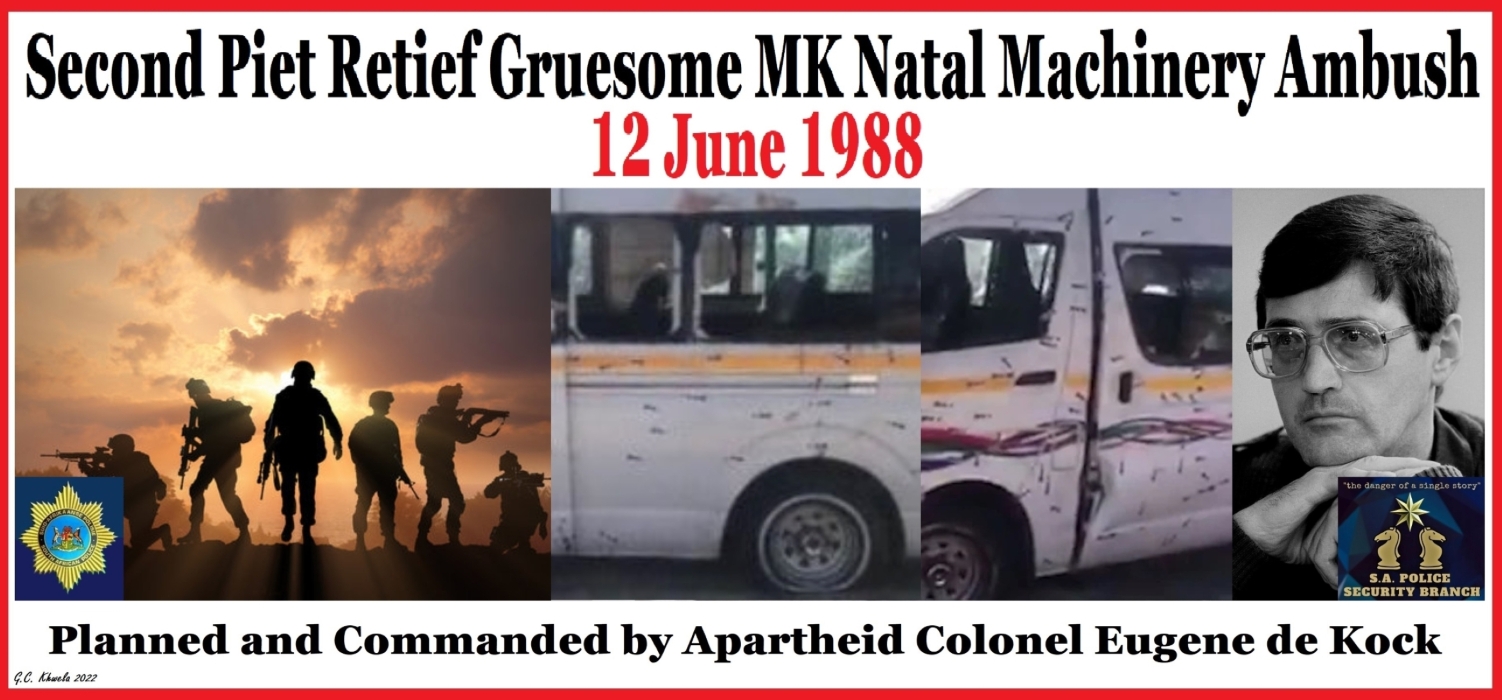
Second Piet Retief Gruesome MK Natal Machinery Ambush
In the morning of 12 June 1988, apartheid Security Police Officer Flip Theron received a phone call from a woman who had assisted them four days previously to carry out a successful ambush against Umkhonto we Sizwe (MK) guerrillas who were infiltrating the country from Swaziland. He told the woman that her information led to a successful operation. The woman then replied that there was another infiltration planned for that night.
Following this tip-off, members of the apartheid Security Branch offices of Middleburg, Witbank and Ermelo arrived in waves in Piet Retief during the course of the day. Eugene de Kock, Christo Deetlefs and Frederik Pienaar had a conversation wherein de Kock suggested that a second shooting incident in such a short space of time would make it clear to their enemy that there was a security breach, and the Commander on the side, whom they believed was Charles Ndaba of the MK Natal Machinery, would lose control of his network and not be allowed by his superiors to infiltrate people again. De Kock therefore suggested sending a second group into Swaziland so that after the “terrorists” had been sent across the border, the Commander and his companions could be killed as well.
Johan Tait, Marthinus Ras, Cornelius Botha and Paul van Dyk were sent to the Swazi side of the border and were positioned by the road leading to the place where the MK cadres were expected to cross into South Africa. In keeping with De Kock’s expanded plan, they were there to ambush the commanders who were anticipated to send the MK cadres on their way. While they were still waiting, a vehicle stopped about 100 – 150 metres away, and the four security force members heard the sound of the boot being opened, of rifles being cocked, and of footsteps heading in the direction of the border. The policemen waited a while, and then moved towards the empty vehicle, where they determined an appropriate ambush spot.
After a while they heard two people returning from the border, and Van Dyk opened fire on the pair as they started entering the vehicle, with his colleagues following suit. Botha moved closer to the vehicle after they had ceased fire, and next to the car was a dead man with a Makarov pistol in his possession. The other man had apparently managed to escape, who they presumed was Charles Ndaba, because the dead man was not Ndaba, but was later said to be Bongani Emmanuel Gasa (aka “Martin”). Botha then shot the car’s petrol tank and Ras set it alight with matches.
Meanwhile, on the other side of the border, Detective Sergeant Manzini was driving a Nissan E20 minibus on the Houtkop-Piet Retief road. As he approached the blue-gum tree, he put on the left indicator and then jumped out of the car and ran round the vehicle. Eugene de Kock ran towards the vehicle and when he was about a metre away, the left front door opened and a man climbed out with an AK-47 assault rifle. De Kock opened fire with his Uzi-9mm machine pistol, and killed the man, and also noticed a barrel of an AK-47 pointing at him from the back seat of the car.
However, at that stage some members of his Vlakplaas Unit had taken up positions diagonally behind him and opened fire on the minibus, and others formed a line behind the minibus, thus opening fire through its back window. Following this excessive rain of fire on the minibus, De Kock gave a ceasefire signal. Four African males, Jabulani Sibisi, Joseph Boxer Mthembu, Howard Sifiso Nxumalo and Nkosinathi Bruce Thenjwayo, were killed in the process, each of them carrying an AK-47 rifle.
The following day, on 13 June 1988, when Ayanda Dlodlo, a female MK Military Intelligence Operative, who was also the Head of the section of the Natal Machinery responsible for the infiltration of cadres, returned from Angola to Swaziland, she met her second-in-command, Phila Ndwandwe, and asked about what happened to “UMakhosi” (Makhosi Nyoka). Ndwandwe mentioned that she was sent on a reconnaissance mission with three other cadres, on 8 June 1988, to establish the safety of the route for the second, larger team, to be safely dispatched. However, when Makhosi failed to return, they assumed the route was clear and safe, so they sent the second team, on 12 June 1988. That was how nine young MK combatants got slaughtered on the same spot within a period of four days.
It was later established that Ms Lita Nombango Mazibuko (maiden surname Kunene) was responsible for the transport arrangements of two groups of MK personnel in June 1988. Her handlers at Piet Retief Security Branch provided transport and drivers and both groups were ambushed and killed on 8 and 12 June 1988. It was after these “successful” ambushes that Mazibuko was paid for her services. She was subsequently apprehended by MK intelligence and severely tortured. Her handler, Flip Coenraad Theron, testified at the Truth and Reconciliation Commission (TRC) that on her return to South Africa, Lita Mazibuko reported to him and was paid a further sum for her involvement.
During the inquest into the Piet Retief ambushes, for example, Colonel Eugene de Kock’s command of the 12 June 1988 operation was not disclosed. The inquest’s presiding officer, a magistrate, not only accepted De Kock’s version of events, but he ignored several highly irregular acts committed by the police in an attempt to cover up their actions. The vehicle in which the infiltrators had travelled was removed before any ballistic examination was done. No photographs of the inside of the car were taken and the Makarov pistol which police said was found next to one of the bodies was not sent for fingerprint analysis.
Furthermore, the four bodies had at least 62 entry wounds, which were much more than the number of shots the police claimed they had fired. The clothes of the deceased, which were full of blood, were burnt without any investigation having been conducted. The person who was referred to as the investigating officer maintained that he was afraid that the clothes might have been infected with AIDS (acquired immunodeficiency syndrome). The magistrate eventually found that there was not enough evidence to show malice on the part of the security policemen.
Sources:
African National Congress, “Further Submissions and Responses by the African National Congress to Questions Raised by the Commission for Truth and Reconciliation”, 12 May 1997.
Truth and Reconciliation Commission, “Lita Nombango Mazibuko”, Truth and Reconciliation Commission: Women’s Hearings, 29 July 1997.
Truth and Reconciliation Commission, “Truth and Reconciliation Commission of South Africa Report”, Vol. 2, 29 October 1998.
Truth and Reconciliation Commission, “Truth and Reconciliation Commission of South Africa Report”, Vol. 6, 21 March 2003.
Truth and Reconciliation Commission, “Truth and Reconciliation Commission of South Africa Report: Victim Findings”, Vol. 7, August 2002.
Thula Simpson, “Umkhonto we Sizwe: The ANC’s Armed Struggle”, Penguin, 2016.
Jacques Pauw, “Into the Heart of Darkness: Confessions of Apartheid’s Assassins”, Jonathan Ball, 1997.
Castro Khwela
Good evening fellow Compatriots!
Discover more from CASTRO KHWELA
Subscribe to get the latest posts sent to your email.