
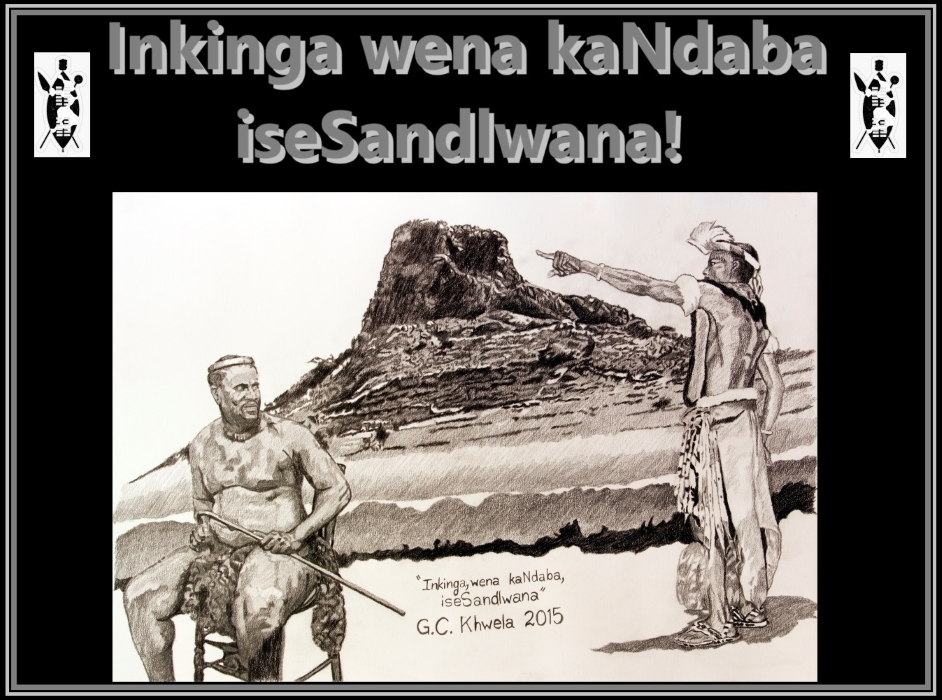
(The Complication, Son of Ndaba, is What Happened at Isandlwana)
“… the Zulus … did what no European army can do. Armed only with lances and spears, without any firearms, they advanced under a hail of bullets from breech-loaders up to the bayonets of the English infantry – the best in the world for fighting in closed ranks – and threw them into confusion more than once, yea, even forced them to retreat in spite of the immense disparity of weapons …” – Friedrich Engels: The Origin of the Family
Friederich Engels was marvelling at the victory of the Zulu impis of INgonyama uCetshwayo over the British Imperial Army at Isandlwana Hill on 22 January 1879. At that historic battle the entire central column of a British invasion army – the most modern and well-equipped that the world’s leading power could put into the field – was skilfully outmanoeuvred and wiped out by African warriors. Nine hundred British troop were speared to death as well as a similar number of African Native levies under British officers.
The battle – as the heyday of British Empire and colonial might – is regarded as one of the most humiliating defeats in the annals of Britain’s military history, “the greatest disaster since the Crimean War”. New of INgonyama uCetshwayo’s unexpected and overwhelming victory stunned Victorian England and sent shockwaves throughout colonial South Africa. The arrogant British Commander, Lord Chelmsford, retreated to Durban in consternation and disgrace. There he waited for thousands of troop reinforcements which were soon to pour in from all corners of the Empire.
For the time being the predatory colonial war ground to a dead halt, although there could be no doubt about its ultimate, tragic outcome. The Zulus had won a signal battle, but for them, as for all the brave indigenous people of our country, there could be no question of winning the war. The British imperialists liked to boast that their’s was an Empire “on which the sun never set”; it was in fact an Empire “on which the blood never rand dry”.
Isandlwana could be no more than a pyrrhic victory. There was no gloating among the Zulu. When reports of the battle reached him, INgonyama uCetshwayo remarked: “An assegai has been thrust into the belly of the nation. There are not enough tears to mourn for the dead.”
What are the lessons to be learnt from the Battle of Isandlwana?
There are two essential points which must be grasped, not simply from the victory of Isandlwana (which cannot be viewed in isolation) but from that whole glorious era of military resistance. They are both of essential importance for the liberation of our country, South Africa.
Firstly: there exists an indomitable fighting spirit among all our people, which has as its basis the resistance to the wars of dispossession. This spirit resides deep in the psychological make-up of our people and cannot be denied. What better quote than Nelson Mandela’s statement from the dock in Pretoria? “In my youth in the Transkei”, Mandela declared, “I listened to the elders of my tribe telling stories of the old day … I hoped and vowed then that, among the treasures that life might offer me, would be the opportunity to serve my people, and make my own humble contribution to the freedom struggles.”
Secondly: the unity of our people, which was not possible a hundred years ago, is of paramount importance today. In citing the struggles of the past, we stress the common heritage, the common enemy, the common struggle. … The burning lesson of our history is that the struggle of our people must be united, with a single common goal which it is treason to lose sight of: PEOPLE’S POWER OVER EVERY INCH OF AN INDIVISIBLE SOUTH AFRICA.
Whilst finding inspiration in the deeds and traditions of the resistance – Khoi, San, Xhosa, Pedi, Sotho, Tswana, Zulu, Pondo, Ndebele, Griqua, Venda, Shangaan – we must build the unshakeable unity of ll. We must deepen the unifying national consciousness of all our people – African, Indian, so-called Coloured, and democratic White – which is a prerequisite for … A NATION-WIDE VICTORY IN THE STRUGGLE TO FASHION A SOCIETY ALONG THE LINES OF OUR FREEDOM CHARTER.
The courage of our ancestors survives. The spirit of the oppressed is resilient. Autocratic regimes are vulnerable. We are living in an age where history is on our side.
Extracted and adapted from Alexander Sibeko, “An Epic of African Resistance”, The African Communist, No. 76, First Quarter, 1979.
Castro Khwela
Good morning fellow Compatriots!🙏🏾✊🏾👊🏾
Discover more from CASTRO KHWELA
Subscribe to get the latest posts sent to your email.


Thank you for this piece on Impi Yase Sandlwana Cde Castro. I will use it on my radio show later today with credits to you as I have done before. Well done with the various pieces ypu have issued reminding us where we come from.
Is it still necessary to use the qualification of democratic when including ‘whites’ in nation building project? There are a significant proportion of coloured’s and Indian’s who vote DA, or for Gayton’s party now, and a significant proportion of black voters who vote for barely disguised ethnic parties like the MKP, not to mention the DA. Surely Nation Building in the face of fierce competition from China, India, the Philippine’s, Taiwan, and now even Vietnam, means that we simply have to build the united, just and equal nation for all, by all?