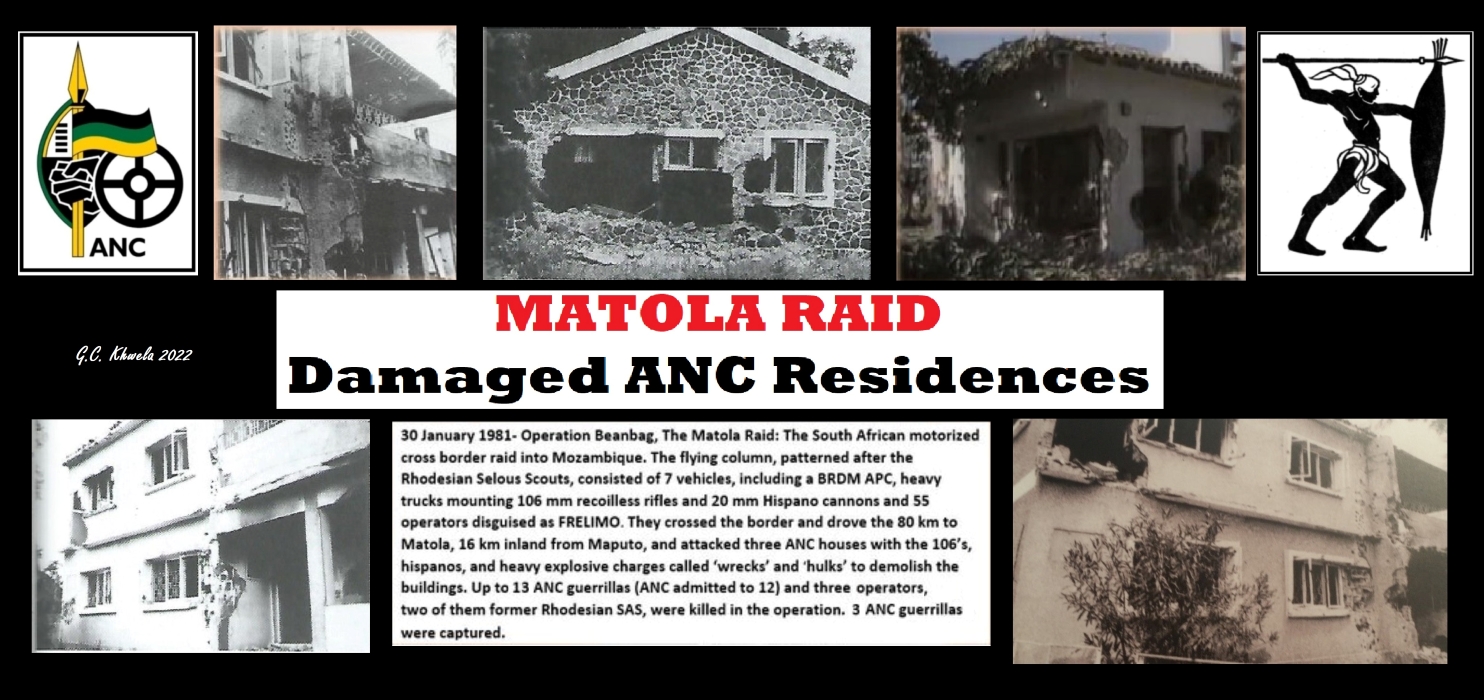
Sometime towards the midnight of 29 to 30 January 1981, Dick Mtimkulu, the watchman on duty at the headquarters of Umkhonto we Sizwe’s (MK’s) Special Operations Unit in Matola, alerted four of his colleagues that there were a lot of soldiers outside. Mtimkulu then went upstairs to wake Montso “Obadi” Mokgabudi, the Unit Commander, who was sleeping on the upper floor with Solly Mayona, Mochudi and Sipho Thobela. Mtimkulu, Mokgabudi and Lati Ntshekang (who had been sleeping on the bottom floor) went outside, while Thobela tried to get back to sleep.
When the three men reached the gate, they saw black soldiers dressed in Mozambican Army uniforms. One of these soldiers ordered them to kneel down, and when they obeyed, the soldier confiscated Mokgabudi’s pistol and watch. The same soldier ordered them to take of their shoes, and after that instructed them to proceed to the white wall, where they were slashed around the sides of their faces and ears with what felt like razor blades or knives, causing them to cry out.
Sipho Thobela heard these cries and got up, seeing his comrades lined up as if by a firing squad, took his AK-47 and began firing at the men in the yard. The soldiers fired back, seriously wounding Montso Mokgabudi, while they also fired back at the house. Other members of the attacking force, who remained in the rear of the property as their colleagues went to knock at the front, opened fire and threw grenades at the house’s windows. Montso “Obadi” Mokgabudi staggered away from the scene of the attack on the Special Operations Unit, with his guts being ripped open. He was taken to hospital, but later, after more than a week, succumbed to his wounds.
Authentic Mozambican Army troops, located about 457 metres to the rear of the property, were alerted by the noise. A party of them proceeded to the house and opened fire over the back wall. This counter-attack compelled the raiders positioned at the rear of the house to withdraw to their vehicles. Sipho Thobela escaped the house through the roof, and climbed across a tree, and saw a body of a white soldier, who was later identified as Sergeant Robert Hutchinson, one of the fatalities suffered by the assault team, including Sergeant Ian Sutill, both of them being ex-Rhodesian Selous Scouts. Another casualty of the apartheid security forces, who was not officially mentioned, was Corporal Jim Parks, who died of grenade shrapnel wounds when the group returned to their assembly point.
Elsewhere in Matola, at roughly the same time, there was another attack by the racist Special Forces, on a residence of the MK Natal Machinery. Mduduzi Guma (aka “Nkululeko”) and Lancelot Hadebe (aka “Sobantu”) were killed instantly when an upstairs bedroom was struck by a rocket. Another MK Cadre, Krishna Rabilal (aka “Goodwin”), staggered from the room badly wounded, only to be mowed down at close range by the attackers.
At a third ANC property in Matola, belonging to the South African Congress of Trade Unions (SACTU), William Khanyile (a protégé of Harry Gwala in the Natal trade union and underground movement) lied dead after being killed by a rocket that was fired through the wall of the bedroom in which he was sleeping. Other ANC casualties included Mandla Daka, Daniel Molokisi, Steven Ngcobo, Vusumzi Ngwema, Thabang Bookolane, Collin Khumalo, Levinson Mankankaza, Felix Magubane and Albert Mahutso. Themba Dimba and Mbulelo Musi were among those who were injured and taken to hospital in Maputo.
Meanwhile, the soldier who ordered the cadres to kneel down during the attack on the Special Operations Headquarters found Lati Ntshekang lying down and kicked him. Ntshekang immediately got up, only for the soldier to order him to lie face down. He took Ntshekang’s hands and tied them behind his back and led him to a military truck. Before they reached the truck, seeing the Special Operations building on fire, one of the soldiers asked Ntshekang if “Obadi” was in the house. Ntshekang responded in the positive, and he was then asked if Faku and Victor (of the SASOL Raid) were there, and Ntshekang said they were in Swaziland.
Ntshekang was asked who he was, and he said he was “Ghost”, and was then asked if “Chief” (Joe Slovo) was also in the house, and he said no. The apartheid security forces had long identified Joe Slovo as the prime orchestrator of the ANC’s military campaign. A South African Intelligence Report compiled on 9 December 1980 stated Slovo’s address in Maputo, his parking space, his security profile and his routine. Ghost was then taken on board the truck and was driven to a place in the bush where he was quizzed further, and ended up at Vlakplaas, as an “Askari”.
Towards the end of 1980, the apartheid South African security forces devised a plan (codenamed “Operation Beanbag”) for a simultaneous attack on African National Congress (ANC) properties in Swaziland and Mozambique. The former was charged to the security police, the latter to SADF Special Forces.
On 5 December 1980, Brand Fourie, South Africa’s Director-General of Foreign Affairs, and three of his colleagues met a three-person Mozambican delegation headed by Minister of State for Security Affairs, Jacinto Veloso, in Paris, France. Fourie stated that Pretoria feared the situation with the ANC in Mozambique may be developing over time to be akin to that with the South West African People’s Organisation (SWAPO) in Angola, whereby it would become an “irritant” and action could be taken.
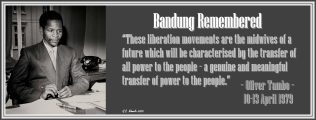
Following the Matola raid, ANC President Tambo responded immediately and characterised the attack as a “crime perpetrated against the people of Mozambique as well as the people of South Africa”, which was to be treated as a “lesson” to an audience of thousands two days later. According to Tambo, the attack on residences was unprovoked, for there were no ANC or MK camps in Mozambique.
“It was not covered by any of the normal excuses for aggression… We have not been told that every white household, every residence occupied by families in South Africa is such a base or camp,” Tambo argued. “If the qualification to make a house a camp is that people living in it can use a gun, we need to know. …Because every white man in South Africa can use a gun and there are weapons in every household. Are these bases too?”
Tambo reminded all present that the struggle in the southern African region was inseparable: “Mozambique will never grow, Zimbabwe will never – for as long as there is oppression and racist domination in South Africa, we shall not know independence. And the enemy is attacking: LET US REPLY!”
Oliver Tambo’s response followed a prediction he had made in the January 8 Statement the same year, which emphasised that “… we must be under no illusions. The forces of international reaction have been re-grouping, determined to retrieve some of their losses. We face a very different year of struggle. We shall need one another and all our allies and friends the world over. We shall need to fight for unity, and fight in unity for Victory.” – President O.R. Tambo, “Extend and Defend Our Revolutionary Gains!”, Sechaba (March 1981).
Castro Khwela
Good morning fellow Compatriots!
Discover more from CASTRO KHWELA
Subscribe to get the latest posts sent to your email.