The Pango Mutiny: Part 2 – Recovering the Camp
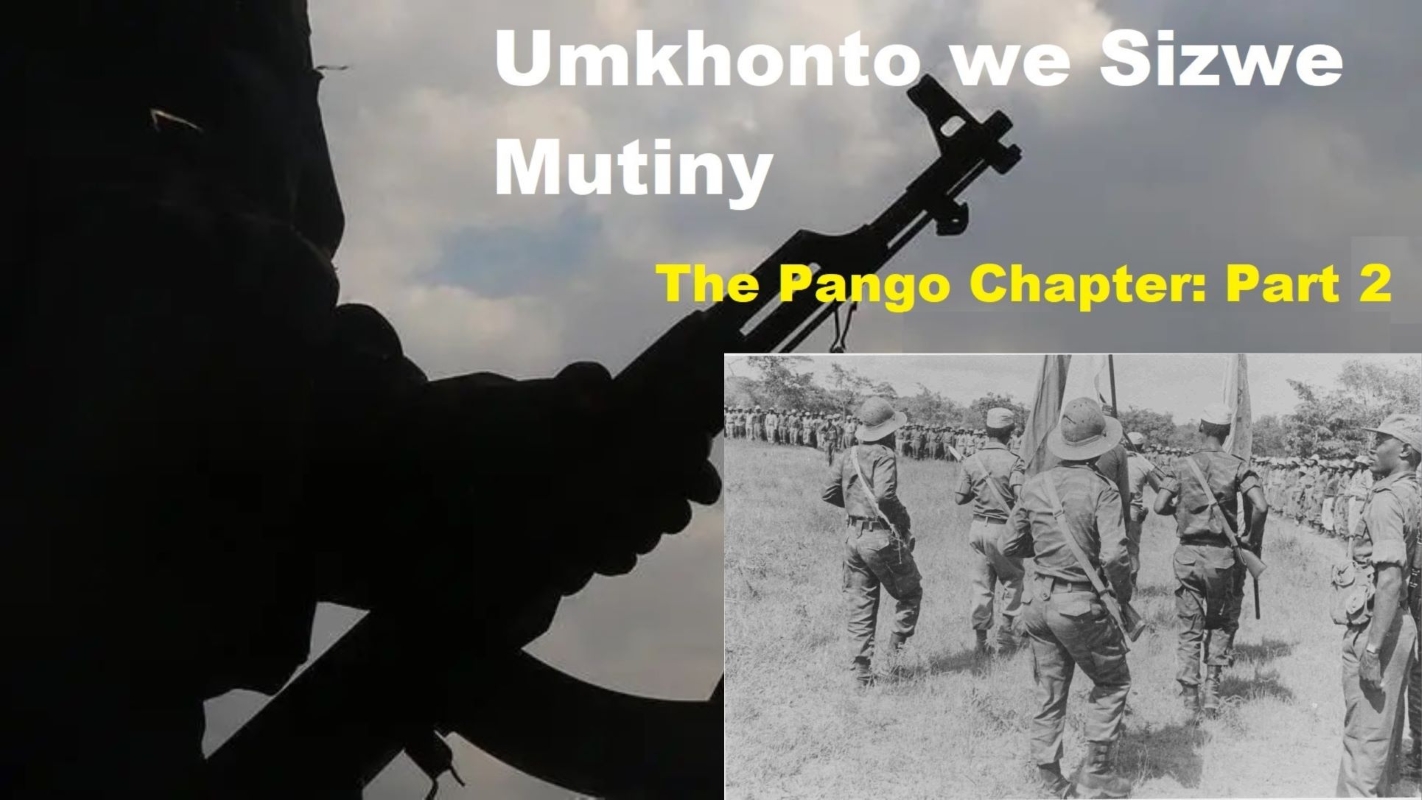
On 18 May 1984, the Umkhonto we Sizwe (MK) Regional Command in Angola, under the leadership of Timothy “Bra T” Mokoena, had assembled a crack loyalist force to recapture Pango camp and restore order and authority. The group charged with recapturing the camp included Raymond “Mshengu” Monageng, then Regional Chief of Staff, who was dubiously later arrested in 1988 as an “enemy plant”, and Lennox “Lagu” Tshali, former MK Army Chief of Staff and later African National Congress (ANC) Chief Representative in Mozambique, who was deployed to assist in Angola.
After having encircled the camp, the direct assault commenced at 05:00 in the morning and ended by dusk, after a pitched battle in which some 14 – 16 people died. A number of mutineers were captured, but some seventeen rebels managed to break through the cordon and escaped into the open bush. Following the recapture of the camp by loyalist forces, a military tribunal was immediately established, headed by Sizakele Sigxashe and five others, with instructions “to look into the problems that led to the pinnacle of counter-revolution at our camp on the 13th of May 1984”.
The tribunal began work on 22 May, and after taking testimony from 66 people, it found that “a clique of reactionary elements within our ranks” had taken control of Pango Camp, killing five and injuring four others. Several captured mutineers, namely James Nkabinde, Ronald Msomi, Bullet Mbumbulu, Thembisile Hobo, MaHero, Wandile Ondala and Stopper Nyembezi were publicly executed by firing squad on 24 May, and their bodies were buried in a mass grave. Another person succumbed to malaria while awaiting execution. Fourteen others were recommended for demobilisation from MK, and 29 were referred to face minor charges.
Two ringleaders of the Pango Mutiny, Wellington “Philosophy” Sejake and “Bazooka” Mbulawa, remained at large among a group of some 17 hardliners heading towards the Zaïrean border. The group soon ran out of supplies and sought asylum at an Angolan army base, occupied by Soviet experts, in the province of Uige. Their hosts turned them over to the ANC, which detained the whole group after they had surrendered their weapons to the Soviet-FAPLA authorities. They were harshly dealt with and one Jonga Masupa died in the process, and others, like Mgedeza, were found dead in the bushes with bullet holes in them.
When eight others were to be executed at a later date, they were saved from death by the intervention of Gertrude Shope, Head of the ANC Women’s Section. “MaShope”, as Getrude Shope was fondly known in the ANC camps, had volunteered to take the trip from Lusaka to Luanda with Chris Hani, to visit Pango and Camp 32, where some of the young cadres were imprisoned. She was taken aback at what she saw and ordered that the escaped and recaptured cadres, who were held there as prisoners, almost naked, be given proper clothes, and that the ill treatment stop immediately.
Following the presentation of the Stuart Commission’s report, the NEC chaired by ANC President Oliver Tambo, appointed a Committee of Three headed by Gertrude Shope, to investigate and report on conditions at Camp 32 (aka “Quatro”). Returning to present their report to the NEC at head office, Shope and Hani did not sufficiently uncover the worst conditions at the detention camp, where it later transpired that systematic violence and torture were used to extract information from the detained suspects and duly convicted prisoners, especially relating to the details of the mutiny.
The protests and the mutiny of 1984 became known in MK circles as “Mkatashinga”, from an Angolan Kimbundu word referring to the burden carried by a “demonised” cadre. The leader of the Pango Mutiny, Cekiso Hoyi (aka “Ronald Msomi”), was reputedly chosen as leader on account of his exploits against UNITA. He was the son of Inkie Hoyi, a Ciskei headman whose house in Duncan Village, East London, was attacked by MK during the Sabotage Campaign in 1962.
Another prominent fatality was Ephraim Nkondo (aka “Zaba Maledza”), who was considered to be the pre-eminent figure in the Committee of Ten, and was officially said to have hanged himself in an isolation cell in “Quatro” (Camp 32) in the early morning of 28 May 1984. Other deaths included a detainee, Dumile Yokwe (aka “Selby Mbele”), who died on 3 December 1984 of rheumatic fever in Luanda’s security prison. Another detainee, 22-year-old Phillip Makou (aka “Ben Tibane”), died seven days after being arrested in the Luanda prison, who was described as “a confessed enemy agent”.
The list of the comrades who were killed during the ferocious skirmishes in Pango, besides Zenzile Phungula, Wilson “Willie” Sithole, Duke Maseko and Cromwell Qwabe, included Patrick Mabitse (aka “Gibson Mazibuko”), Raymond Mbaule (aka “Sticks Mayathula”), Mfana Lamock Mhlebeya (aka “Ian Mkhwanazi”), Jomo Mphahla (aka “Khumalo Jilly”), Tsotsi Samson Senatla (aka “Clifford Mphefu”) and Samuel Sojaka (aka “Fezi Mehlomakhulu”). The number of those who died is often given as seven or eight, however, based on the names above, those who killed in the Pango skirmishes from 13 to 18 May 1984 adds up to ten.
The end of the episode at Pango closed the chapter of a disconcerting period within the history of MK. In April 1985, thirteen detainees were released from the Luanda prison and one from a group that was imprisoned in Quatro. On 12 April, all the remaining mutineers in prison in Luanda were transported to Quatro under heavy escort of security personnel. Shortly thereafter the National Executive Committee decided to hold a National Consultative Conference the following year, in Kabwe, Zambia, in June 1985.
Sources:
Luli Callinicos, “Oliver Tambo and the Dilemma of the Camp Mutinies in Angola in the Eighties”, South African Historical Journal, Vol. 64 No. 3, 2012.
Stephen Ellis, “External Mission: The ANC in Exile”, Jonathan Ball, 2012.
James Ngculu, “The Honour to Serve: Recollections of an Umkhonto Soldier”, David Philip, 2009.
Paul Trewhela, “Inside Quatro: Uncovering the Exile History of the ANC and SWAPO”, Jacana, 2009.
Hugh Macmillan, “The Lusaka Years: The ANC in Exile in Zambia – 1963 to 1994”, Jacana, 2013.
Luli Callinicos, “Oliver Tambo: Beyond the Engeli Mountains”, David Philip, 2004.
Castro Khwela
Good day fellow Compatriots!
Discover more from CASTRO KHWELA
Subscribe to get the latest posts sent to your email.