Thami Mnyele Coldheartedly Murdered: 40 Years On
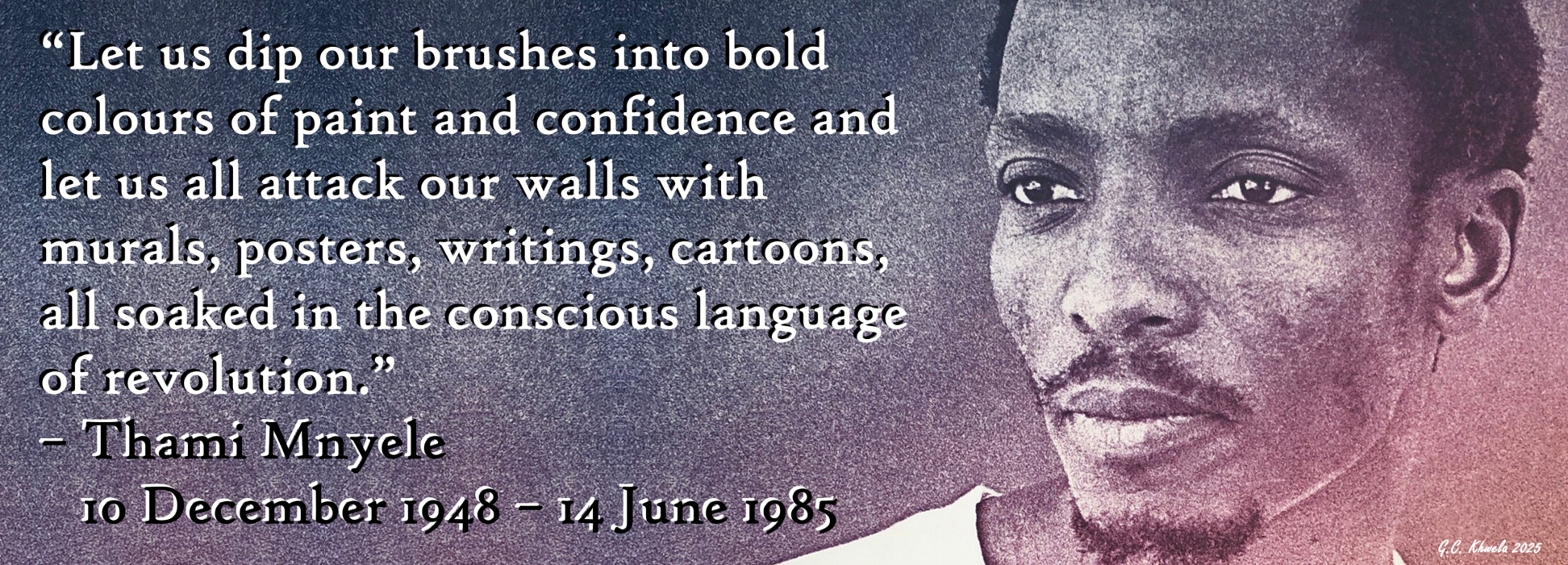
On 14 June 1985, Thami Mnyele was shot dead by apartheid South African Defence Force (SADF) soldiers outside his home in Gaborone. He had planned to move to Lusaka the following day and the SADF stole large collections of his works that were packed into a portfolio. A week later, apartheid security policeman Major Craig Williamson displayed the portfolio and the works in it on the South African Broadcasting Corporation (SABC) television, as evidence of Mnyele’s “terrorist” activities. To date, these works have not been recovered from the security police.
Thamsanqa “Thami” Mnyele was born the third of five children, on 10 December 1948, in Alexandra Township, near Johannesburg. His father was a minister of religion and his mother a domestic worker. In the sixties, his father and mother separated, and Thami was sent to live with his brother, and later his uncle. By the late 1960s, his mother sent him to a boarding school in Pretoria. He loved art from an early age but there were no art classes. He used pens, pencils and paper material to draw at the age of 14. In his last year of school (Matriculation), his mother could no longer afford school fees, so he left school.
In 1971, Mnyele joined Mhloti Black Theatre, and by then he decided that his personal direction lay with the visual arts. In 1972, Mnyele secured a grant to the Evangelical Lutheran Church (ELCSA) Art Centre, in Rorke’s Drift, in the then Natal province, where he received one year of formal art training with a number of other black artists. After this training, he worked as an illustrator for the SACHED Trust for seven years, as he was the family breadwinner and had to remain employed in Alexandra in order to help his mother keep her house. He called for artists in the struggling communities to use their talent to express people’s demands.
In June 1976, Mnyele, Fikile and Ben Arnold held an art exhibition at the Dube YWCA. The Dube exhibition, located physically within the June 1976 uprising, received no attention in the Johannesburg art world, or in the press. But it became a signpost of a new attitude towards the arts, one which permeated resistance culture for the next decade and a half. Thami vehemently rejected any separation between his art and the demands of South African resistance.
In 1979 Mnyele was forced into exile in Botswana, where he became a leading figure within the Medu Arts Ensemble and a committed African National Congress (ANC) cadre. He vehemently rejected any separation between his art and the demands of South African resistance against the apartheid regime. Medu Arts Ensemble members preferred to call themselves “cultural workers” rather than “artists”. The term implied that art makers should not see themselves as elite and isolated individuals, touched by creative madness or genius; but simply people doing their work, whether painting, music or poetry.
In the early 1980s, Thami Mnyele also spent some time training in Umkhonto we Sizwe (MK), the ANC’s military wing, camps in Angola, and later moved to Lusaka. During this period he worked with ANC printers designing posters, mastheads, and even stickers under the ANC’s name. He also designed the first draft of the current ANC logo during this period. In the years in Botswana, Mnyele made and exhibited graphics, drawings, and fine arts, and organised cultural workers through Medu Arts Ensemble. In those years he also participated fully in Umkhonto we Sizwe (MK) activities. Mnyele chaired the Gaborone Culture and Resistance Festival in 1982, and gave the keynote addresses. He was also a spokesperson for South Africa’s visual artists at the follow-up conference in Amsterdam in 1983.
According to Mongane Wally Serote, “In life and struggle, the boers have robbed us of a good friend and fine comrade. His life, his presence was a series of little actions, soft-spoken statements, that have accumulated into profound meaning here and now. He touched us. We are instructed! … And there is no doubt, the ANC had nurtured Thami the man, Thami the cultural worker into a new man the new South Africa is awaiting. Thami fell at his post, a resolute man, optimistic about the future and ready to take up his next assignment.”
In his own words, Thami defined culture in the following manner, “For me as a craftsman, the act of creating art should complement the act of creating shelter for my family or liberating the country for my people. This is culture.” – Thami Mnyele
Sources:
Wikipedia.
South African History Online (SAHO).
Mongane Wally Serote, “Thami Mnyele: A Portrait”, Rixaka, No. 3, 1986.
Castro Khwela
Good morning fellow Compatriots!🙏🏾✊🏾👊🏾
Discover more from CASTRO KHWELA
Subscribe to get the latest posts sent to your email.