MK Approaching Gatsha Buthelezi for Guerrilla Bases in Zululand
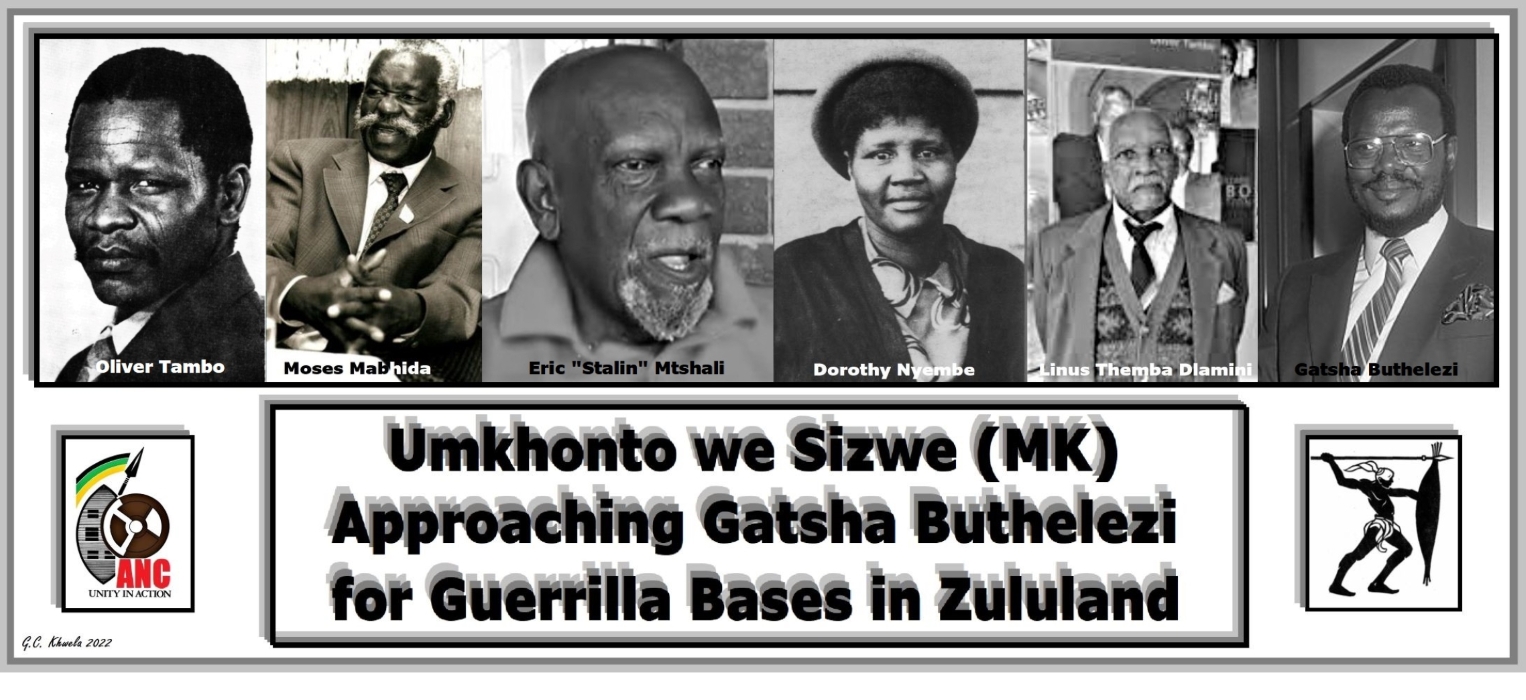
On Sunday, 14 July 1968, while Chief Mangosuthu Gatsha Buthelezi was attending mass at the Anglican Church in Nkonjeni, Mahlabathini District of Zululand, he received a message from one of his children, and went out to meet a certain woman by the name of Dorothy Nyembe. Nyembe introduced him to Linus Themba Dlamini who had a letter from Moses Mabhida in Lusaka.
Buthelezi said he knew Mabhida as an African National Congress (ANC) leader, and after a short discussion, Dlamini asked Buthelezi if there was a suitable coast in Zululand for submarine landings, and whether the Buthelezi tribe would be willing to take up arms if weapons were supplied. Buthelezi said no, his people were not willing to do that.
At the time of the Wankie Campaign, ANC Acting President Oliver Tambo had entrusted Umkhonto we Sizwe (MK) Political Commissar Moses Mabhida with the responsibility of executing the plan to infiltrate an advance team of operatives into South Africa through another route so that by the time the MK cadres made their way into South Africa through Rhodesia, and by sea, reception networks would be well established.
Mabhida, in turn, instructed Eric Mtshali, an MK intelligence operative, to recruit seamen to help smuggle the advance team of MK members and propaganda material into the country by sea. According to Mtshali, many of these seamen who frequently sailed through Dar es Salaam were from Durban, and he knew and recruited them to undertake dangerous underground tasks for the movement. This was how Mtshali managed to arrange for Bifana Matthews Ngcobo, Amos Lungephi Lengisi and Themba Linus Dlamini to return to the country as stowaways. Those earmarked for this mission were given advanced training in intelligence and underground work in the Soviet Union.
About two weeks prior to the three guerrillas penetrating the country as stowaways, Ngcobo approached Walter Zulu in Dar es Salaam, who was a crewman in a vessel named the “Clan Ross”. On the following day, Zulu and Ngcobo met again and Ngcobo was told to go to Mombasa to meet the ship there. In Mombasa, Kenya, Bifana Matthews Ngcobo and Walter Zulu met again and Ngcobo took Zulu to meet Amos Lengisi, whom he introduced as a friend who wanted to join them on the trip to South Africa.
A few days later, Lengisi and Ngcobo arrived at the “Clan Ross” and Zulu locked them in the cabin until the ship was at sea. Once the ship was on its way, Zulu transferred the two to the engine room until it docked in Cape Town on 19 February 1968. In a subsequent trip from Mombasa, Walter Zulu smuggled in his own brother, Isaac, and Themba Linus Dlamini, whom he linked with Dorothy Nyembe. Matthews Ngcobo, Linus Dlamini and Amos Lengisi had been infiltrated into the country as part of the efforts in the late 1960s to revive the underground.
Linus Themba Dlamini and Bifana Matthews Ngcobo operated in the Durban area, where Dlamini was given shelter by Dorothy Nyembe, who subsequently assisted him with his underground tasks. Bifana Ngcobo was arrested in Durban on 25 September 1968, and while in detention revealed the whereabouts of Amos Lengisi, leading to his arrest in the Transkei the next day. Lengisi recalled that before his arrest, he and his team had managed to set up structures in the Eastern Cape, Cape Town and the Orange Free State, and had offered basic military training to a number of recruits. Each batch of newly trained cadres was expected to set up their own structures so that they could provide support for returning guerrillas.
Linus Dlamini evaded the police for at least eight months before he was arrested on 20 September 1968 at Dorothy Nyembe’s house at K6, KwaMashu, and Nyembe also found herself back in the hands of the security police and both were held in solitary confinement for many weeks. Eventually, in January 1969, they were brought to court along with nine other men and charged on five counts under the Suppression of Communism Act. The 1969 Pietermaritzburg trial of ANC cadres who had entered the country after undergoing training abroad “and managed to conduct important underground work before they were detained” was “the first admission by the authorities of the existence of ANC underground activity” during the second half of the 1960s.
All, but one, of the accused were found guilty and sentenced to terms ranging from 5 to 20 years imprisonment. Dorothy Nyembe was found guilty of one charge – that of “harbouring terrorists”, for which she was sentenced to 15 years imprisonment. The rest, including Linus Dlamini, were found guilty of various charges under the Terrorism Act, including going abroad for military training; establishing means for trained guerrillas to re-enter South Africa; locating suitable submarine landing sites on the coast; encouraging people to go for military training and giving assistance to freedom fighters.
A number of the other accused in the Pietermaritzburg trial – Lawrence Phokanoka, Patrick Matanjana, Daluxolo Luthuli, Gebolkangwe Seleka and Silas Mogotsi – had taken part in the Wankie campaign. Some were arrested during the course of the fighting in Rhodesia or while making their way to South Africa, while others were picked up by the police after they had reached South Africa. Patrick Matanjana was arrested at Wankie, Daluxolo Luthuli were apprehended at Plumtree and Gebolkangwe Seleka was caught on a train in Rhodesia. One of the accused, Silas Mogotsi, and an accomplice witness, Leonard Mandla Nkosi, were among the guerrillas in the Wankie campaign who had successfully made their way to Durban through Rhodesia.
The arrest of Dorothy Nyembe, and the evidence provided by enemy agents Leonard Mandla Nkosi and Charles Makhaye (aka “Morris Mandela”), as well as Mangosuthu Gatsha Buthelezi, during the trial, sent shockwaves through the ranks of the small ANC underground units in Natal. Gatsha Buthelezi claimed that the visit by Dorothy Nyembe and Linus Themba Dlamini was a trap to arrest him, since among the “insurgents” of the External Mission of the ANC she (Dorothy Nyembe) brought at KwaPhindangene, in Mahlabathini, were already in cahoots with the Security Branch. According to Gatsha Buthelezi, “the Security Police encouraged this man (Linus Themba Dlamini) to come with Dorothy Nyembe to bait me”.
Amos Lengisi recalled that after his arrest, he and Bifana Matthews Ngcobo sent a message to the ANC External Mission that Buthelezi should be protected from going to prison. and if required to testify against them, he should be allowed to do so. Lengisi added that Buthelezi’s evidence was not necessarily damaging to the accused in the trial. However, this was not that accurate, since it had a damaging effect on both Linus Themba Dlamini’s and Dorothy Nyembe’s cases.
Sources:
Wikipedia.
South African History Online (SAHO).
South African History Archives (SAHA).
Thomas Boatman, “An Unmistakable Figure: Biography of Dorothy Nyembe”, South African History Online, 3 February 2021.
Christopher Merrett, “Born Out of Sorrow: Essays on Pietermaritzburg and the KwaZulu-Natal Midlands under Apartheid, 1948−1994, Volume One”, Occasional Publications of the Natal Society Foundation, 2021.
Jess Basson, “Dorothy Nyembe”, WordPress, 17 May 2017.
Saths Cooper, “Jury Out on Buthelezi’s Legacy”, Sunday Tribune, 27 August 2023.
Thula Simpson, “Umkhonto we Sizwe: The ANC’s Armed Struggle”, Penguin, 2016.
Sandi Sijake, “Fighting for My Country: The Testimony of a Freedom Fighter”, Jacana, 2024.
Gregory Houston, et. al., “Report – Transcripts of Interviews with Veterans of the South African Liberation Struggle, Volume 1”, Human Sciences Research Council, March 2015.
Anti-Apartheid Movement (AAM) Archives, “Women in the Anti-Apartheid Movement: Dorothy Nyembe”, Anti-Apartheid Legacy, 10/2023.
Sechaba Profile, “Dorothy Nyembe”, Sechaba, Vol. 8, Nos. 8/9, August-September 1974.
Tim Jenkin, “Welcome Home, Dorothy Nyembe, Women’s Leader”, Sechaba, March 1984.
Gregory Houston, “Chapter 15: The Post-Rivonia ANC and SACP Underground”, The Road to Democracy in South Africa, Volume 1 (1960–1970), South African Democracy Education Trust, Zebra, January 2004.
Castro Khwela
Good evening fellow Compatriots!
Discover more from CASTRO KHWELA
Subscribe to get the latest posts sent to your email.