ANC Supports Joint Call for June 16 Stay Away
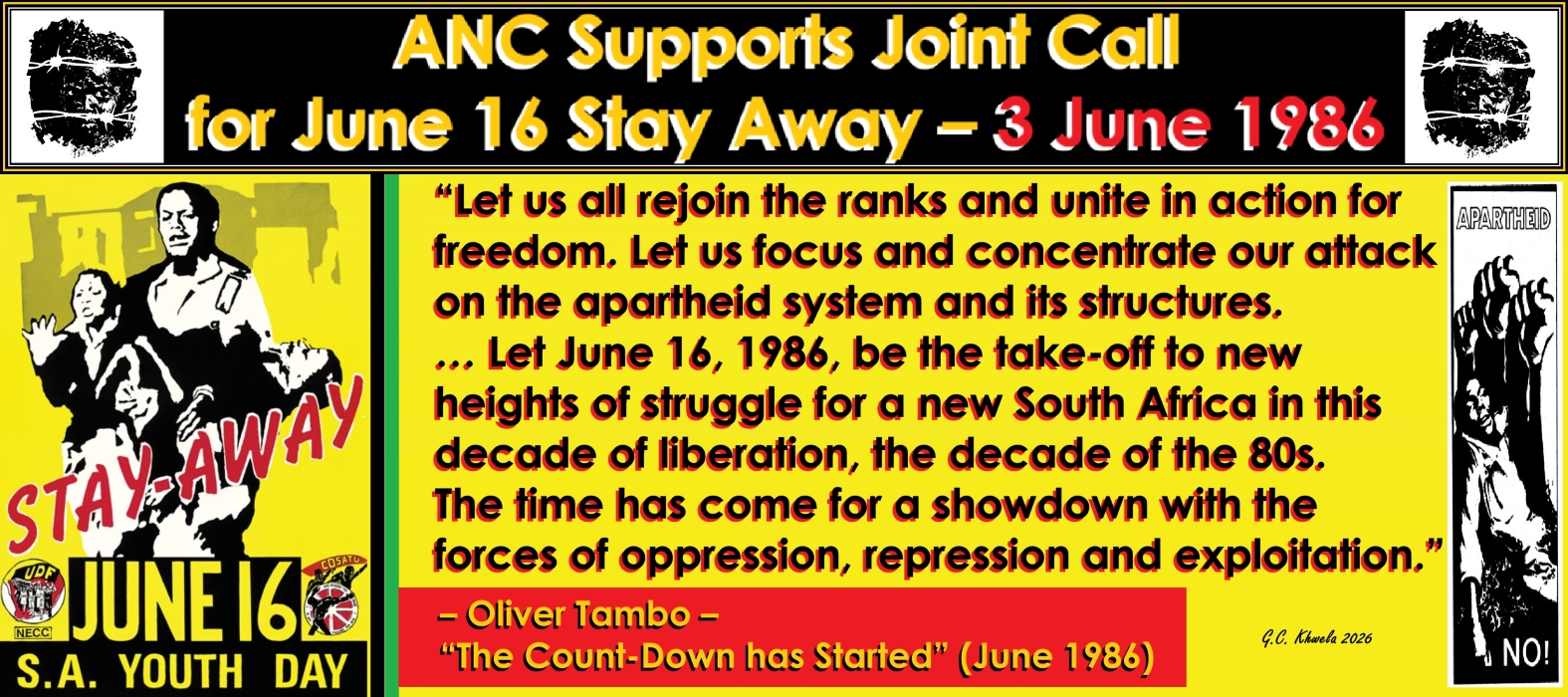
On 3 June 1986, the Congress of South African Trade Unions (COSATU), the United Democratic Front (UDF) and the National Education Crisis Committee (NECC) grouped to issue a call for a “One Day Work Stay-Away” on June 16. The call was issued to all South Africans, Black and White, in commemoration of the Youth of 1976, who were killed in the streets of Soweto while protesting against the Bantu Education system. The aim was to ensure that June 16 be regarded as a public holiday throughout the country with commemorative mass rallies and activities organised for that day.
From exile, the African National Congress (ANC) supported the 16 June 1986 “One Day Work Stay-Away” by broadcasting directives on Radio Freedom, coordinating international diplomatic sanctions, and deploying Umkhonto we Sizwe (MK) to engage in an armed offensive as part of the entire defiance effort. Because the ANC was banned inside South Africa at the time, its leadership in Lusaka, Zambia, acted as the external wing that amplified and militarised the domestic call made by COSATU, the UDF and the NECC.
This historic joint declaration carried significant political weight as the mass stay-away was called to commemorate the 10th anniversary of the 1976 Soweto Uprising, during which apartheid police killed hundreds of students protesting against the forced use of Afrikaans in the Bantu Education system. The organisations demanded that 16 June be recognised as an official public holiday across South Africa, and the action was intended to shut down the economy for the day to allow millions of South Africans, both Black and White, to participate in organised commemorative rallies and community resistance activities.
Prior to the joint statement, the predominantly student-led NECC had initially proposed a three-day strike. By collaborating with COSATU (representing over 500,000 workers) and the UDF (the largest anti-apartheid coalition), they consolidated student, community and labour forces into a highly coordinated front. The call directly challenged the apartheid regime and fearing the magnitude of this coordinated defiance campaign, President P.W. Botha responded just days later by declaring a national State of Emergency on 12 June 1986. The emergency unleashed broad powers to detain activists, ban meetings and enforce strict media censorship in the run-up to the June 16 anniversary.
The ANC supported the stay-away by utilising its clandestine shortwave radio station, Radio Freedom, to beam daily messages into South Africa. They urged workers, students and township residents to defy the state’s threats and strictly observe the stay-away. Radio Freedom was used to bypass the severe media censorship and information blackouts imposed by the apartheid government’s State of Emergency, assuring locals that the world was watching. The ANC also directed its armed wing, Umkhonto we Sizwe (MK), to increase sabotage operations and guerilla activity across the country during this period. By actively engaging security forces in armed clashes, MK units aimed to stretch the apartheid police and military thin, thereby protecting striking workers and localised township rallies from total suppression.
Furthermore, the ANC timed its international diplomatic push to coincide exactly with the stay-away. On 16 June 1986, the ANC orchestrated a massive World Conference on Sanctions against Racist South Africa, which was held at the Unesco House, in Paris. The Movement successfully used the 12 June release of the Commonwealth Eminent Persons Group (EPG) report – which concluded that apartheid could not be reformed – to lobby the United Nations Security Council for strict economic and military sanctions while the strike paralysed South Africa internally. Ultimately, the ANC’s external and underground apparatus acted as a force multiplier, transforming a domestic labour strike into a coordinated global and military offensive against the apartheid state.
Prior to 16 June 1986, ANC President Oliver Tambo issued a powerful anniversary statement titled “The Count-Down has Started”, which explicitly praised the domestic coalition, calling for a “massive defiance” to break the apartheid regime’s newly declared national State of Emergency and to render the country “ungovernable”. In the statement Tambo said the following:
“On June 16, 1976, as we all know, the children of Soweto, Mamelodi, Gugulethu and other areas rose united in response to a massacre unprecedented in its nature and scale. On the occasion of the tenth anniversary of that uprising, the youth and students, the children, parents, teachers and other professionals; the workers in town and country, on the mines, in commerce, industry and the farms; the religious community – in fact, the entire oppressed population together with democratic whites are bound together by the blood that covered the streets of Soweto, the blood that has since soaked the soil of our motherland in even bigger quantities.
“On this truly historic occasion the nation will pay fitting tribute to the young heroes and martyrs, including eight-year-olds, who fell in that titanic battle against the forces of apartheid repression. And so the repression we experience today is not new. But as we can see today the sacrifices of those heroes and martyrs were not in vain. The declaration of yet another state of emergency, this time across the length and breadth of the country, means that the entire people of South Africa, black and white, the oppressed and the oppressor, friend and foe alike, are focussing on the tenth anniversary of the Soweto Uprising, the South Africa Youth Day.
“This means that the Botha regime has wittingly or unwittingly defined Monday June 16, 1986, as the biggest national occasion since Soweto. It deserves to be and we shall make sure that it is. The declaration of the state of emergency at this time means that the struggle has intensified and spread to every part of the country, uniting all our people against the apartheid system. It means the regime has been pushed to the limits of its repressive capabilities.
“The state of emergency means, as Botha admits, that the ordinary laws of apartheid domination, the iron chains which have bound us hand, foot and mouth over the decades, have become inadequate to halt the mounting popular offensive against white minority rule and exploitation of our labour. The use of vigilantes and impis has failed to serve Botha’s purposes. The regime has been forced by the relentless advance of the democratic forces in our country to come out from behind the vigilante defence lines and undertake itself the task of defending the system. It is forced to take on the people’s offensive. We stand face to face not with surrogates but with the racists themselves.
“This helps to clear any confusion there may have been as to who we are fighting, what we are fighting and what we are fighting for. With the state of emergency, the enemy is there for all to see. The lines are clearly drawn: the fighters for a non-racial, democratic and united South Africa on the one side and on the other the armed defenders of the apartheid crime. This is the struggle the ANC and the democratic movement is leading. It is the people united in action against baaskap, for baaskap is baaskap by any other name.
“As the struggle has grown and reached unprecedented levels of intensity, the apartheid regime, faced with the irresistible advance of the masses, decided to hire black policemen, black vigilantes and black impis, to fight, murder and die in its defence. Hence the so-called black-on-black violence, an expression which is a distortion of reality. It is of course part of the apartheid survival strategy that the slave master should hire slaves to save him from the revolt of the enslaved. But this strategy, like all its predecessors, has failed. That is why Botha resorts to desperation of the state of emergency.
“The stark reality of the South African situation is that the people are inexorably, irresistibly rising up from slavery. Victory is calling and we earnestly urge all our people to leave Botha to do his own thing, to defend the indefensible if he dare. Let us all rejoin the ranks and unite in action for freedom. Let us focus and concentrate our attack on the apartheid system and its structures. Let none defend this doomed system or its tottering structures. Our people must refuse to be used against their own interests, against their own future, for the perpetuation of their own domination.
“Apartheid must not be left to die a natural death when it is something like 70 years old or more. It must be destroyed now. Those who say it is dead have no reason to defend it, and our unity in action must make its mark on the tenth anniversary of Soweto. Let June 16, 1986, be the take-off to new heights of struggle for a new South Africa in this decade of liberation, the decade of the 80s. The time has come for a showdown with the forces of oppression, repression and exploitation.
“Fighting with us are the peoples of the world. International pressures are being mobilised at this time as never before, precisely around the tenth anniversary of the Soweto Uprising. We have had the report of the Group of Eminent Persons submitted on 12th June. On June 16 one of the biggest world conferences to deal with the South African situation and decide on appropriate measures in the form of sanctions is taking place in Paris. And this week the United Nations Security Council is meeting again to discuss and decide on the situation prevailing in South Africa.
“A people determined to challenge the South African regime in all its strength, with all its states of emergency, is a people that can only be rewarded with victory. And the tenth anniversary of Soweto will see a challenge of this state of emergency in massive defiance, with Umkhonto we Sizwe and its units and detachments moving into action across the country. All this adds up to spell a new and unparalleled crisis for the Pretoria racist clique. The countdown has indeed started. We must sustain the momentum of our offensive for the destruction of the system and the creation of a new order in our country.”
THROUGHOUT THE COUNTRY, IN OUR TOWNSHIPS, COUNTRYSIDE AND WHITE AREAS THE ORDER IS: ATTACK, ADVANCE, GIVE THE ENEMY NO QUARTER!
Sources:
South African History Online (SAHO).
Oliver Tambo, “The Count-Down has Started”, Dawn – Monthly Journal of Umkhonto we Sizwe, Vol. 10, No. 4, 1986.
Castro Khwela
Good evening fellow Compatriots!🙏🏾✊🏾👊🏾
Discover more from CASTRO KHWELA
Subscribe to get the latest posts sent to your email.