Mozambican Independence and the African Revolution
Mozambican independence on 25 June 1975 fundamentally reshaped the African revolution by shattering the “White Redoubt” in Southern Africa, accelerating the collapse of neighbouring minority-ruled regimes, and establishing a radical, Marxist-Leninist operational base for the wider continent’s liberation movements. The structural and geopolitical ripple effects of the victory by the Mozambique Liberation Front (FRELIMO) altered the trajectory of Pan-African decolonisation across several distinct arenas.
Mozambique’s independence directly crippled the white-minority government of Rhodesia (now Zimbabwe). President Samora Machel closed Mozambique’s borders, cutting off landlocked Rhodesia’s vital access to Beira and Maputo ports. This enforced international sanctions and strangled their economy.
Prior to 1975, apartheid South Africa relied on Portuguese colonies as a physical geographic buffer against independent, black-governed African states. The sudden fall of Portuguese rule brought the frontline of the anti-apartheid struggle directly to South Africa’s northeastern doorstep. Mozambique also provided a massive, direct sanctuary and operational staging ground for Robert Mugabe’s Zimbabwe African National Liberation Army (ZANLA) forces. This allowed guerrillas to launch highly effective cross-border operations that forced the Ian Smith regime to the negotiating table.
FRELIMO opened safe havens and logistical corridors for Umkhonto we Sizwe (MK), the armed wing of the African National Congress (ANC), as well as the South African Communist Party (SACP). This catalysed a new wave of internal resistance inside South Africa. Mozambique proved to the rest of the continent that a highly organised, prolonged guerrilla warfare strategy could successfully defeat a heavily armed Western-backed military power. Under Samora Machel, the country became a living laboratory for radical socio-economic transformation, immediately nationalising land, implementing massive healthcare and literacy drives, and attempting to construct an explicitly socialist African society free from colonial structures.
The sheer intensity and financial drain of the guerrilla war waged by FRELIMO, alongside liberation movements in Angola and Guinea-Bissau, broke the political will of the Portuguese military. This directly triggered the April 1974 Carnation Revolution in Lisbon, which overthrew Portugal’s Estado Novo dictatorship and permanently ended centuries of Portuguese African colonialism. FRELIMO successfully defeated the Portuguese military by utilising a protracted People’s War strategy, which relied on asymmetric guerrilla tactics, deep civilian integration and the establishment of alternative governing structures in liberated zones.
Rather than seeking decisive conventional battles, FRELIMO wore down the Portuguese armed forces through several highly structured military and political lines of effort. FRELIMO operated in small, highly mobile units that utilised the dense bush terrain of northern Mozambique to ambush Portuguese convoys, sabotage communication lines and lay landmines before retreating. Operations began in 1964 from bases in southern Tanzania, crossing the Ruvuma River into the Cabo Delgado and Niassa provinces. FRELIMO deliberately expanded southward toward Tete province by 1968 to stretch Portuguese military logistics thin and threaten the vital Cabora Bassa dam project.
Following the doctrine of revolutionary vanguard warfare, FRELIMO cadres prioritised political education over military action. They won over local populations by convincing them that the war was a collective struggle against colonial exploitation, not just a military campaign. As FRELIMO cleared Portuguese forces out of northern territories, they established alternative state structures in these liberated zones, where they built schools, set up free clinics, distributed land and organised agricultural cooperatives, proving to locals that they could govern effectively. The Movement also broke traditional gender roles by establishing the “Destacamento Feminino” (Women’s Detachment) in 1967. Women served as frontline combatants, political mobilisers, intelligence gatherers and logistical coordinators, effectively doubling FRELIMO’s operational capacity.
To cut off FRELIMO from its civilian support base, the Portuguese military forced hundreds of thousands of Mozambicans into fortified concentration villages called “aldeamentos”. FRELIMO countered this by infiltrating these villages politically and launching precise raids to liberate the inhabitants. In 1970, Portuguese General Kaúlza de Arriaga launched a massive, conventional scorched-earth offensive using helicopter gunships and napalm to destroy FRELIMO’s permanent bases. FRELIMO avoided destruction by scattering into smaller units, letting the conventional offensive exhaust itself, and then launching a major counter-offensive further south into the economic heartland of Manica and Sofala.
FRELIMO maintained secure command centres, training camps and hospitals across the border in independent Tanzania, fully backed by President Julius Nyerere. This provided a safe haven where Portuguese ground troops could not easily retaliate. The Movement masterfully balanced diplomacy to secure heavy weaponry, including anti-aircraft missiles and rocket launchers, from both the Soviet Union and China. This equipment allowed them to shoot down Portuguese aircraft and neutralise Lisbon’s technological advantage.
The People’s Forces for the Liberation of Mozambique (Portuguese: Forças Populares de Libertação de Mozambique) or FPLM’s guerrilla war altered the course of regional history, shifting the balance of power in Southern Africa from white-minority rule to black majority governance. By dismantling Portuguese colonial control, FRELIMO transformed Mozambique from a protective shield for white minority regimes into an aggressive, revolutionary launchpad for regional liberation.
The influence of FRELIMO’s campaign was divided into two distinct historical phases. Before achieving statehood, FRELIMO’s armed campaign acted as a strategic catalyst that overextended minority-ruled militaries and forged essential alliances among liberation forces. In the late 1960s, FRELIMO advanced its guerrilla operations into Mozambique’s western Tete Province. This successfully bypassed the heavily fortified Zambezi Valley, which had previously blocked Zimbabwean freedom fighters entering from Zambia.
FRELIMO allowed the Zimbabwe African National Union’s (ZANU) armed wing, the Zimbabwe African National Liberation Army (ZANLA), to utilise these newly opened corridors. This integration enabled ZANLA to activate the highly effective northeast operational theatre inside Rhodesia. FRELIMO’s operational efficiency forced an informal military pact between Portugal, Rhodesia and apartheid South Africa (known as the “Alcora Exercise” – colloquially referred to as the “Unholy Alliance”). South Africa and Rhodesia were forced to deploy military personnel, helicopters and financial aid into Mozambique to bolster struggling Portuguese forces, spreading their own domestic security resources dangerously thin.
The successful multi-front challenge led by FRELIMO to a NATO-backed European power elevated the international standing of the national liberation movements of Southern Africa coalition. It created reliable networks for Soviet and Chinese weaponry to bypass colonial blockades, paving a logistics pathway used by neighbouring movements. FRELIMO’s victory over Portugal radically elevated the international standing of the national liberation movements of Southern Africa coalition by shattering the myth of Western military invincibility and transforming liberation movements from unrecognised rebel groups into legitimate governments-in-waiting.
By defeating a NATO-backed European power, FRELIMO provided the diplomatic blueprint that elevated the entire coalition across four distinct global arenas. Before FRELIMO’s success, Western powers at the United Nations dismissed Southern African liberation movements as domestic insurgents or “terrorists”. However, FRELIMO’s clear military progress forced the UN General Assembly to recognise the national liberation movements – such as the ANC (South Africa), SWAPO (Namibia), and ZANU/ZAPU (Zimbabwe) – as the “sole and authentic representatives” of their peoples.
FRELIMO’s victory stripped away the Western diplomatic cover that Portugal had enjoyed via NATO. This shift allowed the national liberation movements coalition to successfully push for tougher international sanctions, oil embargoes, and the diplomatic isolation of apartheid South Africa and Rhodesia at the United Nations. Moreover, FRELIMO’s triumph proved to the Soviet Union and China that providing heavy weaponry to African guerrilla forces yielded tangible geopolitical results.
Following Mozambican independence in 1975, the Soviet Bloc and China significantly upgraded their support to the national liberation movements coalition. They shifted from supplying basic small arms to providing advanced weaponry, including anti-aircraft missiles, artillery, and armoured vehicles. This military upgrade fundamentally altered the battlefield dynamics in Angola, Zimbabwe and Namibia.
FRELIMO’s victory vindicated the strategy of the Organisation of African Unity’s (OAU) Liberation Committee, which had long argued that armed struggle was the only way to end minority rule. Once FRELIMO transitioned from a guerrilla force into the sovereign government of Mozambique, it joined Tanzania and Zambia to officially form the Frontline States. This bloc gave the national liberation movements coalition a permanent, sovereign diplomatic voice that could directly negotiate with Western superpowers, completely bypassing white minority governments.
The ability of FRELIMO to expose Portuguese military atrocities, such as the Wiriyamu Massacre, turned Western public opinion against colonial regimes. This exposure energised the global Anti-Apartheid Movement and established direct solidarity networks between the national liberation movements coalition and Western trade unions, student groups and the churches. FRELIMO’s highly organised administrative structures in its ‘liberated zones’ also convinced non-aligned Western nations, particularly Sweden, Norway and Denmark to bypass NATO’s stance. These Nordic countries began providing hundreds of millions of dollars in direct humanitarian and civil aid to national liberation movements, cementing their global legitimacy.
Upon taking power in June 1975, FRELIMO transitioned from a guerrilla movement into a sovereign state government, using its national territory to systematically dismantle minority rule across the region. Immediately after taking power, President Samora Machel applied international sanctions by closing Mozambique’s borders with landlocked Rhodesia. This cut off 80% of Rhodesia’s import/export capacity by severing its access to the vital Mozambican ports of Beira and Maputo. This economic devastation directly forced the Ian Smith regime to negotiate the transition to Zimbabwe.
FRELIMO also opened safe havens and clandestine transit routes for Umkhonto we Sizwe (MK), and this allowed the ANC to bypass South Africa’s fortified northern borders, triggering a massive surge in domestic armed resistance inside the apartheid state. In direct retaliation to FRELIMO’s support for regional liberation, the Rhodesian Central Intelligence Organisation created, armed and financed a militant proxy group called RENAMO (Mozambican National Resistance) in 1976. When Rhodesia collapsed, South Africa’s apartheid military took over RENAMO’s sponsorship, launching a brutal 15-year civil war designed to devastate Mozambique’s infrastructure and punish the FRELIMO government.
Besides the above-mentioned challenges, FRELIMO’s victory led directly to the creation of the Frontline States alliance. In 1980, this political alignment expanded into the Southern African Development Coordination Conference (SADCC), a regional initiative designed to reduce the economic dependence of independent black nations on apartheid South Africa’s transport network and workforce.
SADCC, established via the 1980 Lusaka Declaration, succeeded by treating infrastructure rehabilitation as a form of geopolitical liberation. Rather than attempting a sweeping trade bloc, it used a highly decentralised project-matching strategy. Under this model, specific sectors were assigned to individual member states to methodically dismantle apartheid South Africa’s monopoly on regional logistics.
The organisation tackled its dual goals of transport autonomy and workforce independence through targeted structural strategies. Before 1980, landlocked independent states were forced to route nearly all their exports through South African railways and ports due to deliberate colonial-era integration. SADCC countered this via the Southern African Transport and Communications Commission (SATCC), spearheaded by Mozambique. Extensive international funding was secured to dredge Mozambique’s ports and rehabilitate the Beira and Maputo rail links. This allowed landlocked Zimbabwe, Zambia and Malawi to bypass South African tracks entirely when shipping tobacco, copper and agricultural goods out to the Indian Ocean.
The coalition also revitalised the Tanzania-Zambia Railway (TAZARA) and upgraded the port capacity of Dar es Salaam, ensuring that landlocked frontline copper-belt economies had a reliable northern outlet entirely out of reach of Pretoria’s economic blackmail. Concurrently, SADCC linked regional electricity grids – drawing from sources like the Hwange power station in Zimbabwe and Kafue Gorge in Zambia – to lessen the subcontinent’s collective reliance on South Africa’s Eskom grid.
For nearly a century, South Africa’s Witwatersrand gold and coal mines systematically extracted cheap, disenfranchised migrant labour from surrounding nations. SADCC leveraged state coordination to steadily reverse this dynamic. Armed with Western developmental aid, SADCC funded localised agricultural and industrialisation programmes at home. This gave citizens viable domestic jobs, so they did not have to migrate to South Africa under the abusive compound labour systems.
Through the Southern African Labour Commission (SALC), member states acted collectively to harmonise labour demands, negotiate better conditions, and limit the arbitrary quotas set by South Africa’s Employment Bureau of Africa (TEBA). When South Africa attempted to politically pressure independent states by threatening the mass deportation of foreign miners, SADCC states like Zimbabwe and Botswana successfully absorbed returned workers directly into their expanding national public works and infrastructure projects.
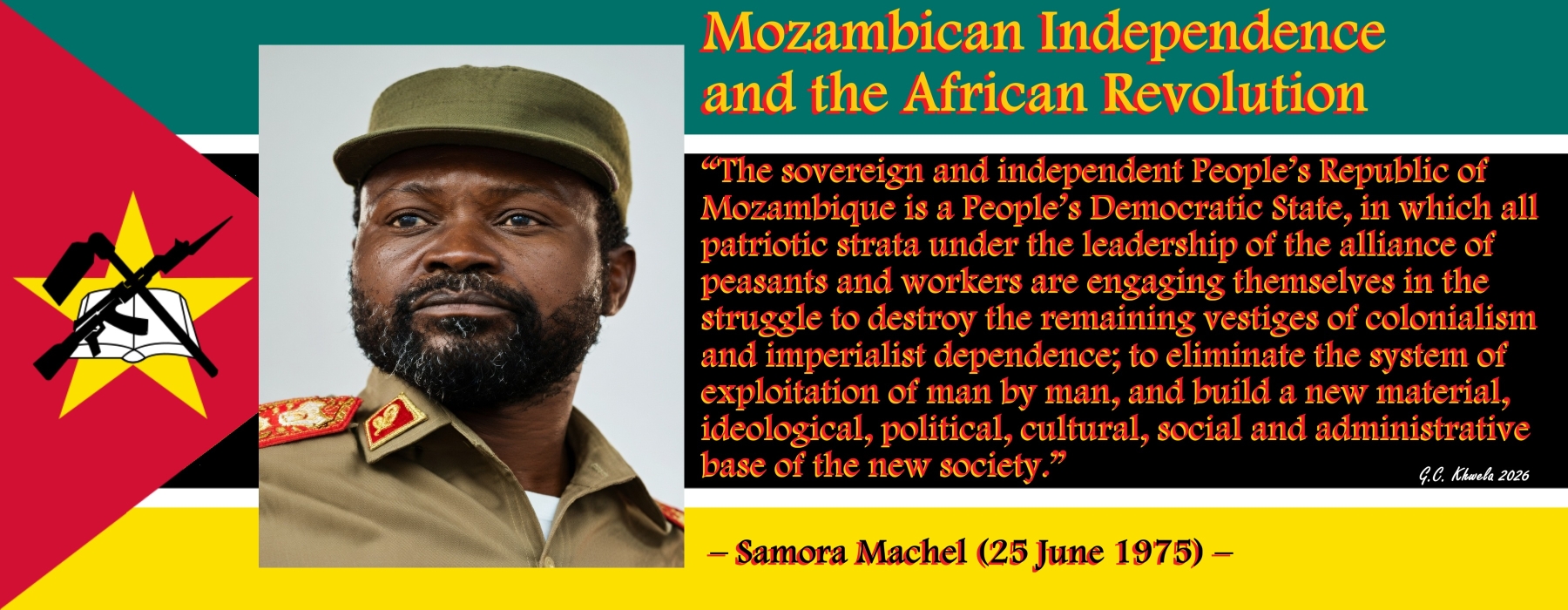
In the words of the then President of Mozambique, Samora Machel, on Independence Day, 25 June 1975, “The sovereign and independent People’s Republic of Mozambique is a People’s Democratic State, in which all patriotic strata under the leadership of the alliance of peasants and workers are engaging themselves in the struggle to destroy the remaining vestiges of colonialism and imperialist dependence; to eliminate the system of exploitation of man by man, and build a new material, ideological, political, cultural, social and administrative base of the new society.”
Sources:
Wikipedia.
South African History Online (SAHO).
Samora Machel, “Mozambique: A Luta Continua! The Struggle Continues!”, Sechaba, Vol. 9, No. 8/9, August/September 1975.
Brid Bowen, “The Southern African Development Coordination Conference (SADCC)”, Trócaire Development Review, Dublin, 1990.
Anti-Apartheid Movement, “The Frontline States”, Forward to Freedom: The History of the British Anti-Apartheid Movement 1959 – 1994.
C.J. Jacobs, “Conflict Between South Africa and Mozambique, 1975-1989, Within the Framework of the Cold War and Regional Tensions”, Journal for Contemporary History, Vol. 34, No. 1, February 2009.
Helge Rønning, “Opinion Piece: Fifty Years Without Peace in Mozambique”, Chr. Michelsen Institute, 21 July 2025.
Shingi, “Seamless Transport Corridors Key to Regional Integration”, Southern African Research and Documentation Centre (SARDC), 4 June 2026.
Kathleen Eddy Sheldon, “Mozambique Under the New State Regime”, Britannica, 12 June 2026.
SADC, “Transport Corridors & Spatial Development Initiatives”, Southern African Development Community (SADC), https://www.sadc.int/pillars/transport-corridors-spatial-development-initiatives
Castro Khwela
Good evening fellow Compatriots!🙏🏾✊🏾👊🏾
Discover more from CASTRO KHWELA
Subscribe to get the latest posts sent to your email.