Signing the Controversial Pretoria Minute
On 6 August 1990, the Pretoria Minute became a historic agreement signed between the apartheid government, led by F.W. de Klerk, and the African National Congress (ANC), led by Nelson Mandela. Building on the earlier Groote Schuur Minute, it aimed to clear legal and political roadblocks to formalise the transition toward democracy. The document focused on mutual concessions to foster a peaceful negotiation climate. The ANC agreed to suspend its 30-year-old armed struggle, conducted via its military wing Umkhonto we Sizwe (MK), with immediate effect. The government agreed to release political prisoners based on defined norms established by a bipartisan working group.
Mechanisms were formalised to provide indemnity and safe passage for exiled anti-apartheid activists returning to South Africa. The apartheid state committed to reviewing and weakening oppressive security measures, including provisions of the Internal Security Act, to allow for free political activity. The government pledged to completely lift the remaining State of Emergency, specifically in the volatile Natal province.
Despite being a breakthrough, the Pretoria Minute triggered intense controversy on both sides of the political divide. Many rank-and-file ANC members, MK cadres and radical movements felt Nelson Mandela made a massive, unilateral concession. They believed suspending the armed struggle stripped the liberation movement of its ultimate leverage before securing universal suffrage or a democratic constitution.
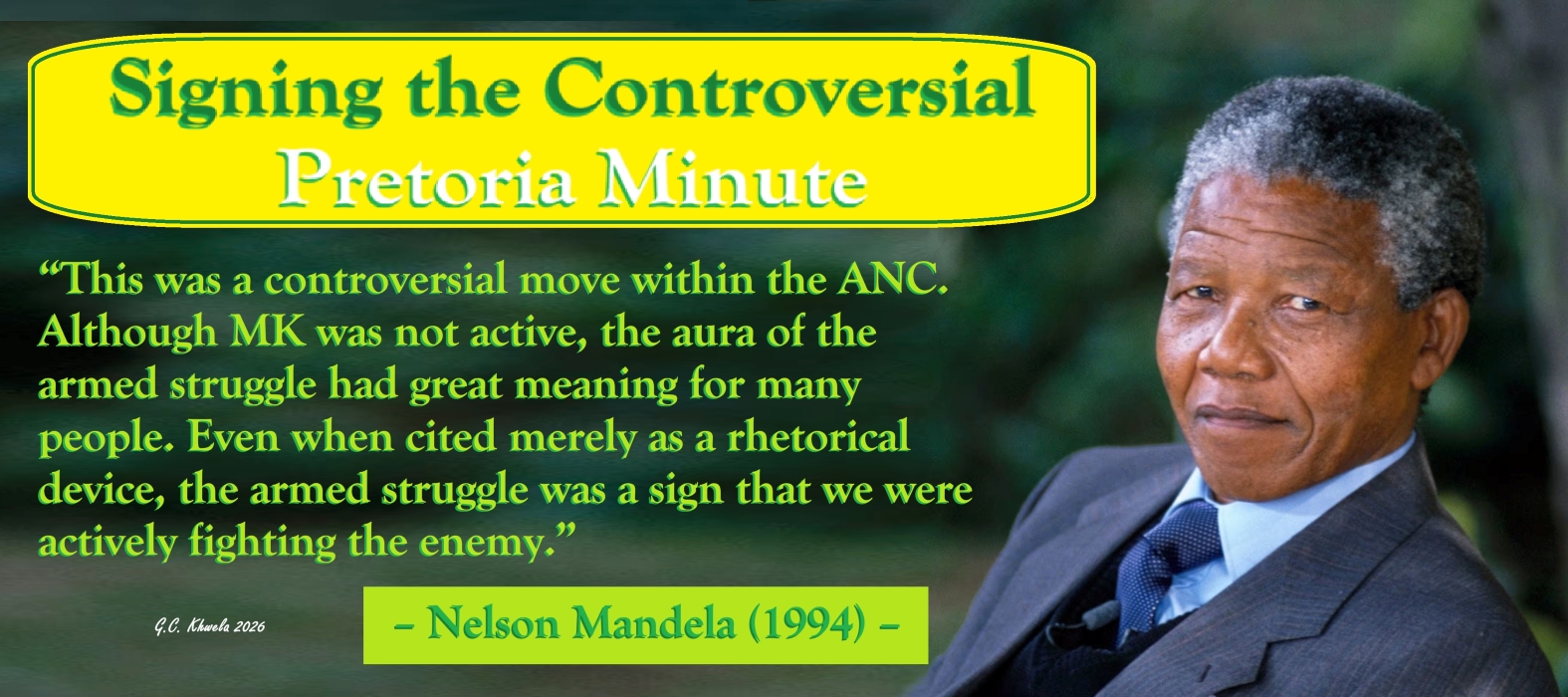
“This was a controversial move within the ANC”, Nelson Mandela agreed. “Although MK was not active, the aura of the armed struggle had great meaning for many people. Even when cited merely as a rhetorical device, the armed struggle was a sign that we were actively fighting the enemy. As a result, it had a popularity out of proportion to what it had achieved on the ground.”
Just two weeks prior to the meeting, police arrested ANC members linked to Operation Vula – a secret underground project to smuggle weapons and leaders into the country to prepare for a revolt if talks failed. The government used this to accuse the ANC of negotiating in bad faith, creating severe distrust.
The ANC later discovered that the agreement was technically not binding on the independent Bantustan “Homelands”. Leaders of territories like Bophuthatswana openly rejected the Minute’s terms, refusing to release political prisoners or allow free political mobilisation within their borders. White conservative factions accused De Klerk’s National Party of capitulating to “terrorists”. They viewed the mass release of political prisoners and the lifting of security acts as a total surrender of state authority. Despite the commitment to peace, state-sponsored “Third Force” violence and bloody clashes between the ANC and the Inkatha Freedom Party (IFP) intensified in the townships immediately after the signing.
The ANC accused the government of violating the spirit of the agreement by continuing to use covert violence to weaken the liberation movement. The ANC’s accusation regarding state-sponsored violence became a major flashpoint that nearly derailed the entire negotiation process over the next two years. Nelson Mandela and the ANC leadership argued that the De Klerk government was waging a dual campaign: negotiating in public while destabilising black communities in secret. This strategy was referred to as a “low-intensity warfare” tactic. The ANC claimed a hidden network of military intelligence officers, rogue police units (like the notorious Vlakplaas), and right-wing elements were actively orchestrating massacres to weaken the liberation movement.
State security forces were accused of providing weapons, training, and financial support to the Inkatha Freedom Party (IFP) to provoke bloody clashes in KwaZulu-Natal and the Witwatersrand townships. The resulting violence terrorised communities, disrupted ANC political organising, and painted a picture to the international community that South Africa would collapse into tribal warfare without white minority rule. Initially, F.W. de Klerk strongly denied these allegations, attributing the township violence to ethnic rivalries and political competition between the ANC and the IFP. However, the ANC’s claims were later systematically proven true.
Media leaks revealed the Inkathagate Scandal in 1991 that the apartheid police had secretly funded IFP rallies and anti-ANC union activities, forcing the demotion of key government ministers. The Goldstone Commission established to investigate public violence, eventually uncovered concrete evidence that senior apartheid South African Police and South African Defence Force (SADF) officers were involved in weapon smuggling and hits on ANC activists. Years later, the Truth and Reconciliation Commission (TRC) confirmed that the apartheid state’s security apparatus had actively operated as a “Third Force” to disrupt the democratic transition.
Historical evidence established that a dual campaign was waged during the transition period. However, historical consensus remains divided over whether President F.W. de Klerk personally directed these covert operations, or if they were carried out by rogue factions within his security apparatus that he failed to contain. The Truth and Reconciliation Commission (TRC) and various judicial inquiries confirmed that while the government negotiated peace in public, state structures were concurrently engaged in widespread, covert actions to destabilise black communities and the African National Congress (ANC).
The covert operation to weaken the liberation movement was executed through several key mechanisms. Elements of the apartheid police and the SADF functioned as an invisible “Third Force”. Rogue units, such as the Vlakplaas counter-insurgency unit led by Eugene de Kock, carried out political assassinations, bombed strategic locations and orchestrated random train massacres to maximise terror in black communities. An internal military investigation by General Pierre Steyn revealed that Military Intelligence (MI) was actively running secret operational centres to derail the transition. It exposed that the military even used left-wing Pan Africanist Congress (PAC) operatives to murder ANC members to foment intra-black conflict.
To counter the ANC’s mass mobilisation, the state weaponised political and ethnic rivalries. They covertly financed, armed and trained the Zulu-nationalist Inkatha Freedom Party (IFP). Public media leaks proved that the apartheid police used state funds to sponsor anti-ANC rallies and union activities. Backed by state support, clashes between the IFP and the ANC spread from KwaZulu-Natal into Gauteng (then the Witwatersrand), resulting in over 14 000 civilian deaths between 1990 and 1994.
The core historical debate centres on what F.W. de Klerk personally knew and authorised. Critics and the ANC argued it was impossible for a head of state to be entirely ignorant of operations funded by his own national budget. De Klerk suppressed or minimised key findings; for example, he hid the written elements of the damning 1992 Steyn Report from parliament, describing it loosely as a “verbal” briefing. Destabilisation directly served his public negotiating position, allowing him to argue that the country required a slow, white-managed transition to prevent “tribal anarchy”.
De Klerk maintained until his death that he never authorised gross human rights abuses or “Third Force” murders. The Goldstone Commission noted that when De Klerk was presented with undeniable proof of military sabotage in late 1992, he dismissed 23 top army officers. This view suggests De Klerk faced a “state within a state”, where deeply entrenched, right-wing apartheid generals acted autonomously to preserve white rule, defying their own president.
Whether driven by De Klerk’s deliberate strategy or his inability to control his generals, the dual campaign ultimately backfired. The horrific escalations of violence – such as the 1992 Boipatong Massacre – outraged the international community and unified the black majority. This forced both the government and a deeply frustrated ANC back to the negotiating table, accelerating the push toward the historic 27 April 1994 democratic elections.
In conclusion, it can justly be said that the Pretoria Minute was a deeply controversial agreement that demanded immense circumspection from the ANC before signing it. By committing to the agreement on 6 August 1990, the ANC leadership took a massive political gamble, trading away their most potent leverage in exchange for government promises that were frequently broken in the months that followed. The ANC’s decision to unilaterally suspend the armed struggle (Umkhonto we Sizwe) was a profound risk. At that moment in history, the apartheid state still held a monopoly on legal violence, controlled the military, and possessed a vast intelligence network.
Many within the ANC argued that suspending armed action before securing a commitment to universal suffrage or a democratic constitution left the liberation movement highly vulnerable. The leadership had to navigate intense internal divisions. Only two weeks prior, the police had exposed Operation Vula – the ANC’s secret underground plan to infiltrate leaders and weapons into the country in case negotiations failed. By signing the Minute, Mandela and the leadership effectively chose to sideline their own hardline military strategists, causing widespread resentment among rank-and-file cadres who felt the leadership was being naive.
The ANC was dealing with a government that had a history of violating pacts. As later proven by the Goldstone Commission and the Truth and Reconciliation Commission, elements of the state security apparatus were already actively fuelling township violence and funding political rivals like the IFP. Signing an agreement based on mutual “good faith” required extreme caution when the state was simultaneously waging a hidden, low-intensity war against black communities.
The text of the Pretoria Minute contained a major strategic blind spot. The apartheid government maintained that the agreement did not automatically apply to the nominally independent Bantustans (like Bophuthatswana and Ciskei). Consequently, the ANC signed an agreement that allowed repression, detentions and the banning of ANC activities to continue unabated across large swathes of South African territory. While the Pretoria Minute successfully kept the peace process on track, the ANC’s initial lack of sufficient guarantees proved costly. The immediate aftermath of the signing did not bring peace; instead, it ushered in the bloodiest period of the liberation struggle, defined by state-sponsored “Third Force” violence and township massacres.
History shows that while the ANC ultimately achieved democracy, a more circumspect approach – such as demanding an international peacekeeping presence or locking in constitutional guarantees before suspending the armed struggle – might have mitigated the devastating violence that followed between 1990 and 1994. This profound lack of trust eventually led the ANC to temporarily walk out of the CODESA (Convention for a Democratic South Africa) talks in 1992, following the Boipatong and Bisho massacres, before the parties returned to the table to finalise the 1994 democratic elections.
Sources:
Wikipedia.
South African History Online (SAHO).
CCCTSA Exhibition, “The Pretoria Minute 6 August 1990”, FW de Klerk Foundation, https://fwdeklerk.org/the-pretoria-minute-6-august-1990/
Allister Sparks, “Letter from South Africa: The Secret Revolution”, The New Yorker, 4 April 1994.
Nelson Mandela, “Long Walk to Freedom”. Abacus, 1994.
Truth and Reconciliation Commission, “Truth and Reconciliation Commission of South Africa Report, Vol. 2”, Truth and Reconciliation Commission, 29 October 1998.
News Agencies, “Apartheid Army’s Secrets Made Public”, Al Jazeera, 1 May 2006.
John Grimes, “Defining “Third Force” Activity: The South African Truth and Reconciliation Commission and Eugene de Kock”, University of New Orleans Theses and Dissertations, 1440, 18 May 2012.
Padraig O’Malley, “The Pretoria Minute 6 August 1990”, O’Malley: The Heart of Hope, Nelson Mandela Foundation, https://omalley.nelsonmandela.org/index.php/site/q/03lv02039/04lv02103/05lv02104/06lv02107.htm
Castro Khwela
Good morning fellow Compatriots!🙏🏾✊🏾👊🏾
Discover more from CASTRO KHWELA
Subscribe to get the latest posts sent to your email.