The Gruesome Bisho Massacre
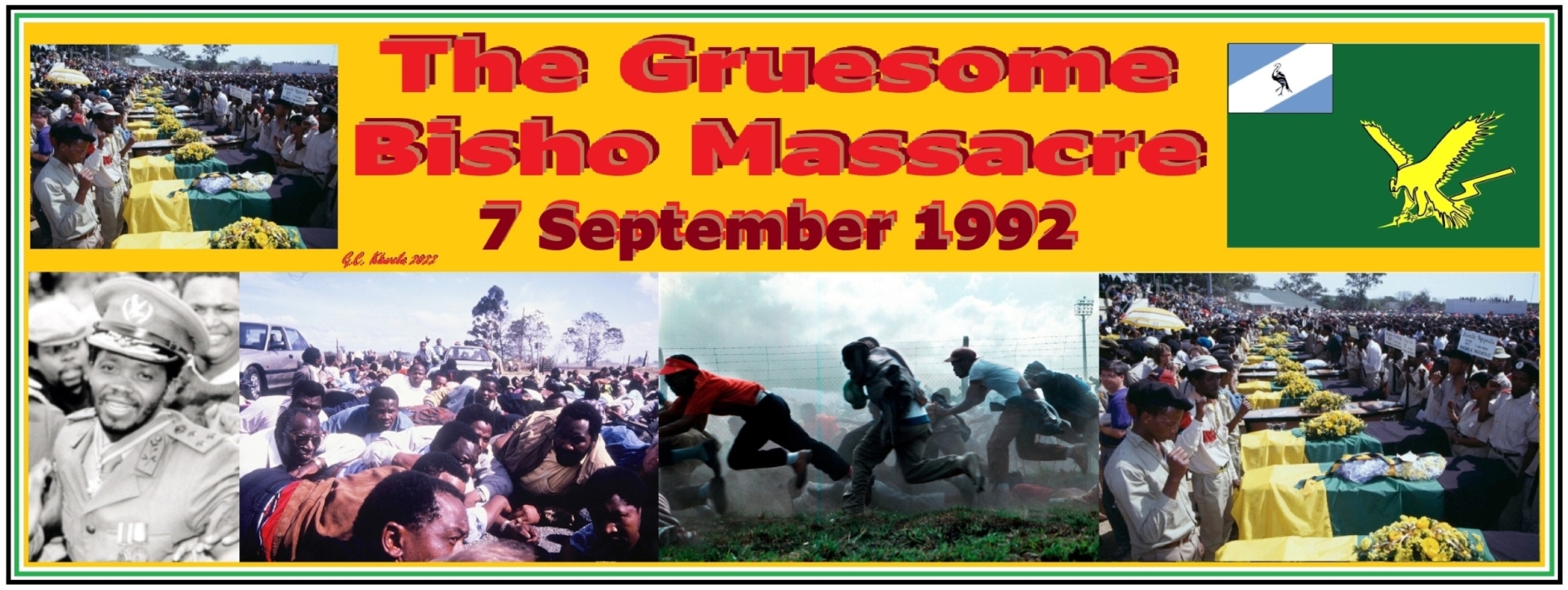
On 7 September 1992, twenty-eight (28) African National Congress (ANC) supporters and one soldier were shot dead by the Bantustan Ciskei Defence Force (CDF) during a protest march when they attempted to enter Bisho (now renamed to Bhisho) to demand the reincorporation of Ciskei into South Africa during the final years of apartheid.
ANC Secretary-General, Cyril Ramaphosa, was ahead of a crowd of approximately 80 000 demonstrators that marched to a razor-wire barrier a few kilometres outside King William’s Town. The march was part of the ANC’s mass action campaign to drive apartheid President F.W. De Klerk to agree to establish an interim government. On 3 September, the ANC sent a memorandum to De Klerk demanding that he replace Gqozo with an interim administration which would permit free democratic activity in Ciskei, but De Klerk refused, on the grounds that the Ciskei did not fall under South Africa’s jurisdiction. At the time, negotiations had broken down, with the ANC withdrawing following the Boipatong Massacre and accusing De Klerk’s government of fomenting the violence.
As a result, the ANC began a campaign of “mass action”, organising a protest march to occupy Bisho and force Gqozo’s resignation. Gqozo sought a court interdict to prevent the march, and the magistrate ruled that it could take place at the homeland’s independence stadium, outside Bisho, but could not enter the capital. The ANC refused to recognise the jurisdiction of the Ciskei court. The protesters gathered outside Bisho, signalling the wide opposition to Gqozo’s rule. The meeting was led by senior ANC leaders including South African Communist Party (SACP) Secretary General Chris Hani, Steve Tshwete and Ronnie Kasrils. A razor wire was erected on the border between South Africa and Ciskei to prevent the marchers from entering Bisho.
Meanwhile, on the other side of the Ciskei Bantustan “border”, hundreds of the Ciskei Defence Force soldiers were cocking their semi-automatic rifles as others on nearby buildings were moving their machine guns into position. At the same time, Ronnie Kasrils was leading a large portion of the crowd away from the main group, as they proceeded towards Bisho Stadium, which was about 60 metres inside the border of the Ciskei Bantustan.
As the crowd led by Kasrils was moving towards the stadium and chanting “Down with Gqozo”, Ramaphosa was engaged in talks with a group of officials representing the “National Peace Secretariat”, which was established as part of the National Peace Accord. The group led by Ronnie Kasrils was prevented from entering the stadium by the razor wire that surrounded its perimeter. However, after realising that on the far side of stadium there was a large gap in the fence, Kasrils led the group of demonstrators through the gap and onto some open grass. The main focus of the group was the central business district of Bisho, where they intended to converge and hold a “people’s assembly” to demand political freedom within the Ciskei Bantustan.
As they were approaching Bisho, they came across a long line of soldiers who were concealed behind parapets and who began opening fire without warning. People started running and screaming and some shouted that people should fall to the ground. Four minutes of machine-gun fire left twenty-nine people (including one soldier) dead and more than 200 injured. Various inquiries agreed that the order to fire came from Colonel Vakele Archibald Mkosana, who incorrectly told his commanders by radio that his troops were under fire, and was given permission to return fire. Rifleman Mzamile Thomas Gonya was also found to have opened fire with a grenade launcher, killing one marcher.
With non-racial democratic elections as the likely outcome of the negotiations, the ANC wished to organise and mobilise its supporters in the Ciskei, particularly as it lay in the Eastern Cape area, a traditional stronghold for ANC supporters. However, its military leader Brigadier Joshua “Oupa” Gqozo resisted this and prevented the ANC from organising. Bisho was the capital of the Ciskei Bantustan, and its government was formed in 1961 under the Bantu Authorities Act of 1951, after the apartheid government declared it a separate administrative territory. In 1972, the status was elevated to self-governing territory. This coincided with stronger efforts to forcibly remove Xhosa-speakers to Ciskei.
On 4 December 1982, Ciskei became an “independent republic”, under President Lennox Sebe, but its independence was not recognised internationally. It was recognised only by the South African government and other “independent” homeland states in South Africa. On 4 March 1990, Brigadier Oupa Gqozo deposed Sebe and ruled as a dictator – despite an initial promise of a swift return to civilian rule. The system of racially segregated homelands had been a core of apartheid, but between 1990 and 1994, negotiations were taking place between the government of South Africa and the African National Congress (ANC) to end the apartheid system.
In 1991, Gqozo formed the African Democratic Movement (ADM) to counter the ANC in Ciskei. In December of the same year, he was part of the Convention for a Democratic South Africa (CODESA) negotiations. CODESA was a forum made up of apartheid government (National Party) and non-government political groups to negotiate a new constitution and the transition to democracy in South Africa. In March 1992, Gqozo accused the ANC of planning to overthrow him and in August he stopped ANC marchers from entering Ciskei from King William’s Town, a town in South Africa, although close enough to Ciskei. However, on 7 September, the same year about 80,000 protesters gathered outside Bisho, signalling wide opposition to Gqozo’s rule.
The Goldstone Commission, which was tasked with investigating the massacre, condemned Gqozo for preventing political activity in Ciskei as well as for the lethal brutality of the Ciskei Defence Force troops. Justice Richard Goldstone also dismissed Gqozo’s claim that the demonstrators had fired first, and it was later found that a Ciskei soldier who died during the shooting had been shot by a fellow soldier. It recommended strong action against Gqozo and those responsible. It also condemned Ronnie Kasrils for his irresponsible action in leading marchers breaking through the razor wire and provoking the forces into opening fire.
A day after the massacre, the ANC released a statement demanding that Oupa Gqozo be removed as the leader of Ciskei, and that Section 43 of the Ciskei National Security Act which prevented political activity in Ciskei be revoked. The ANC also demanded that officials of the apartheid South African Military Intelligence be removed from Ciskei. Ultimately, the massacre led to new negotiations between the ANC and the apartheid government. On 26 September 1992, Nelson Mandela met with De Klerk to sign a Record of Understanding, which established an independent body to oversee police operations.
The Truth and Reconciliation Commission (TRC) only received two applications for amnesty for the massacre, which were from Colonel Mkosana, who gave the order to open fire, and Rifleman Gonya, who fired a grenade launcher. Gqozo agreed to testify before the TRC, but failed to appear after being admitted to a psychiatric hospital suffering from depression. In 2000, both Mkosana and Gonya were denied amnesty on the grounds that their actions were reckless and disproportionate and not associated with a political motive. Following their failure to receive amnesty, Mkosana and Gonya were charged with one count of murder and Mkosana with 28 counts of culpable homicide. They were found not guilty on all charges on the grounds of self-defence.
The Committee found that the actions of Vakele Archibald Mkosana and Mzamile Thomas Gonya who were members of the CDF were not actions constituting acts associated with a political objective. The Committee further found that there was no doubt that some of the marchers acted in breach of the conditions of the permit when they burst towards the stadium. The presiding Judge Denzil Potgieter said, “But to simply open fire on everyone under the pretext of enforcing the conditions of the permit was totally unjustified in the circumstances. Indeed this reaction was irrational and disproportionate and that it cannot be accepted that the leaders of the marchers who left the stadium should have foreseen this reaction.”
Testifying at a TRC hearings on the massacre, Gqozo’s former deputy, Col Silence Pita, revealed that Gqozo had received a message stating that Umkhonto we Sizwe cadres were planning a coup and would take us “where we didn’t want to be”. However, the source of the information was not made clear in the report. Accordingly, Pita added, the security arrangements for an African National Congress march on 7 September 1992 were left in the hands of the Ciskei Defence Force.
Furthermore, former Ciskei “foreign affairs minister” Mickey Webb testified that the Ciskei government had been maneuvered into a confrontation with the ANC by South Africa’s intelligence services. He claimed that South African Military Intelligence and Ciskei’s own intelligence agency fed the Ciskei government with misinformation “which could only have ended up in confrontation between the authorities and the ANC”. Gqozo remained in power in Ciskei but resigned shortly before the elections of 27 April 1994.
On 19 November 1996, hundreds of people packed the East London City Hall to hear a plea for forgiveness from former Ciskei military ruler Oupa Gqozo, who told the TRC that he did all in his power to avoid the Bisho massacre in 1992. Gqozo stood up and turned to look at the massacre victims and their families seated in the first three rows of the 800-strong audience before telling them: “Please forgive me. I know that I do not deserve your forgiveness. I want to tell you from my heart that I never wanted your people to be killed. I will not be surprised if you reject my (apology). You have lost loved ones.”
This poignant event serves as a stark reminder of the tragic events that unfolded on this day in 1992 when 28 people, including one soldier, lost their lives in a harrowing incident. Families who endured the heartbreak of losing their loved ones continue to grapple with the profound impact of this tragedy. As Bisho gathers to remember and honour those who perished, the scars of that fateful day serve as a sombre reminder of the sacrifices made in the struggle for a just and equitable South Africa.
Sources:
Wikipedia.
South African History Online (SAHO).
Abongile Jantjies, “31st Anniversary of Bisho Massacre Commemorated in Eastern Cape”, SABC News, 7 September 2023.
Steve Mdluli, “After Bisho, What Next?”, The Writings of Oupa Lehulere, Publications and Archives, 11 September 1992.
TRC REPORT, “Amnesty Refused to CDF Soldiers for Bisho Massacre”, Truth and Reconciliation Commission, Amnesty Committee, 10 July 2000.
Staff Reporter, “Bhisho Massacre Memorial this Thursday”, Grocott’s Mail, 6 September 2017.
Stephanie Victor, “The Politics of Remembering and Commemorating Atrocity in South Africa: The Bhisho Massacre and its Aftermath, 1992–2012”, Journal of Southern African Studies, Vol. 41, No. 1, 2015.
Mayibongwe Maqhina, “Bisho 20 Years Later”, TimesLIVE, 07 September 2012.
African National Congress, “Bisho Massacre 32 Years Ago on This Day”, African National Congress Online, 7 September 2024.
Laura Evans, “The Bhisho March and Massacre of September 1992: The ‘Leipzig Option’ and the Meanings of Mass Action in the South African Transition,” South African Historical Journal, Vol. 75, No. 3, 2024.
Laura Evans, “The Mass Action Campaign of 1992: The Ciskei Crisis and the African National Congress in Transition”, South African Historical Journal, No. 75, No. 3, 2023.
SAPA, “Gqozo Pleads for Forgiveness for Bisho Massacre”, South African Press Association, 19 November 1996.
SAPA, “No Amnesty for Ex-Soldiers Who Shot Marchers”, Independent Online, 7 September 2000.
Staff Reporter, “Kasrils Returns to Bisho massacre Site To”, Mail & Guardian, 10 September 1999.
David O’Sullivan, “Today is the 28th Anniversary of the Bisho Massacre”, Kaya 959 News, 7 September 1997.
Amnesty International, “Truth and Justice: Unfinished Business in South Africa”, Amnesty International-Human Rights Watch, February 2003.
Thula Simpson, “Umkhonto we Sizwe: The ANC’s Armed Struggle”, Penguin, 2016.
Janet Smith and Beauregard Tromp, “Hani: A Life Too Short”, Jonathan Ball, 2009.
Castro Khwela
Good evening fellow Compatriots!
Discover more from CASTRO KHWELA
Subscribe to get the latest posts sent to your email.