US Blocks Angola’s Membership of the United Nations
Exactly fifty years ago, on 23 June 1976 the United Sates (US) for the fifteenth time vetoed Angola’s application for membership of the United Nations. The move to prohibit Angola from becoming a member was largely prompted by the US’s concern over the “continuing presence of Cuban forces” in the country. Interestingly, the US was the only member that opposed Angola’s application, while China abstained, following accusations that the Soviet Union was interfering in Angola. Amongst the council members who voted for Angola to become a member were Britain, France, Libya, Italy, Tanzania, Japan, Panama, the Soviet Union, Romania and Guyana.
The application received overwhelming support from 13 of the 15 Security Council members, including Western allies like Britain, France and Italy. Because the US held permanent veto power, its single negative vote completely blocked the application. This marked the 15th time overall that the US had exercised its veto power within the Security Council since the creation of the UN. China did not participate in the vote but openly condemned the Soviet Union for interfering in African affairs. Nevertheless, the block did not last long, since later that year, on 22 November 1976, the US shifted its strategy to avoid permanently alienating moderate African nations, the US chose to abstain rather than veto a second application. This allowed the Security Council to pass UN Resolution 397, and Angola officially became the 146th member of the United Nations in December 1976.
According to official statements, the US government argued that the heavy presence and influence of foreign Soviet-bloc troops meant that Angola failed to meet the UN Charter’s requirement of being a truly independent, “peace-loving” state. The US representative to the UN at the time, Albert W. Sherer Jr., stated that there was “no justification for such a large and armed foreign presence in a truly independent state”. The Marxist-led Popular Movement for the Liberation of Angola (MPLA) had taken control of the country with the assistance of Soviet weapons and thousands of Cuban troops. This arrangement directly conflicted with US Cold War interests in Southern Africa, as Washington had been backing rival anti-communist factions like the National Union for the Total Independence of Angola (UNITA) and the National Liberation Front of Angola (FNLA).
However, what is historically accurate is the core narrative that Cuba deployed massive combat forces under “Operation Carlota” to directly defend the MPLA government against a major South African military invasion. The argument was that Cuban leader Fidel Castro launched Operation Carlota on 5 November 1975 as a direct, independent response to South Africa’s unprovoked aggression into Angola. The apartheid South African Defence Force (SADF) had launched “Task Force Zulu” in October 1975, rapidly advancing hundreds of kilometres into Angola alongside UNITA forces. They were rapidly approaching the capital, Luanda, to prevent the Marxist MPLA from taking over power when Portugal officially withdrew on 11 November 1975.
From this viewpoint, Cuban troops arrived as internationalist liberators to protect Angolan sovereignty, successfully halting the apartheid army outside Luanda and eventually forcing their retreat back into South West Africa (Namibia) by March 1976. In contrast, the Western and South African narrative argues that South Africa’s full-scale October invasion was itself a reaction to an increasing footprint of Soviet advisors and Cuban military instructors who had been arriving since the spring and summer of 1975 to help the MPLA defeat rival factions. Declassified documents show a highly fluid and competitive timeline where both sides were escalating simultaneously.
The facts nonetheless reveal that apartheid South Africa feared that a Marxist MPLA government would provide a safe haven and launchpad for guerrillas belonging to the South West Africa People’s Organisation (SWAPO) that was fighting for the independence of Namibia (then occupied by South Africa). But most importantly, the uppermost intention was to secure oil from the Angolan enclave of Cabinda, as a primary economic and strategic motivation for the apartheid regime. From this perspective, South Africa’s intervention was not merely an ideologically driven “anti-communist” campaign, but it was a calculated imperialist resource grab aimed at neutralising its greatest geopolitical vulnerability, energy insecurity due to international isolation.
Apartheid South Africa had no domestic crude oil reserves and was entirely dependent on foreign imports to fuel its military and economy. Following the 1973 OPEC (Organisation of the Petroleum Exporting Countries) oil embargo and intensifying United Nations pressure, Pretoria knew a mandatory global oil sanction was looming. An effective embargo risked bringing the apartheid war machine to a complete standstill within years. Therefore, controlling Cabinda – often referred to as “Africa’s Kuwait” – would have provided South Africa with a guaranteed, direct supply of crude oil, rendering international sanctions ineffective.
Revolutionary perspectives point to the specific military actions in November 1975 to prove this intent. While South Africa’s Task Force Zulu pushed toward Luanda from the south, a separate, coordinated attack was launched against Cabinda from the north. This assault involved the Front for the Liberation of the Enclave of Cabinda (FLEC), heavily backed by Zairian troops and Western mercenaries. Declassified records confirm that South African intelligence agencies and the CIA actively coordinated with Zaire to bankroll and arm these anti-MPLA factions specifically to seize the oil fields.
The threat to Cabinda explains why the Cuban military intervention was not limited to defending Luanda. In early November 1975, Cuban President Fidel Castro deployed a dedicated contingent of Cuban troops directly to Cabinda to fight alongside the MPLA’s armed wing (FAPLA). Between 8 and 12 November 1975, this combined force successfully repelled the Zairian and mercenary offensive, securing the oil fields for the newly declared MPLA government. While Western declassified documents from the era emphasise the Cold War dynamic of stopping Soviet expansion, African revolutionary scholars and leaders heavily emphasised the resource-exploitation angle.
In this view, the apartheid regime sought to install puppet regimes – via UNITA, the FNLA and FLEC – to carve up Angola. This strategy was aimed at keeping the region dependent on Pretoria, protect its occupation of Namibia, and strip Angola of its vast oil and mineral wealth. Backed secretly by the United States’ Central Intelligence Agency (CIA), South Africa framed its aggression as “a pre-emptive strike to block Soviet expansionism in Southern Africa”.
While Cuba had a small number of military advisors on the ground earlier in 1975, it was the overt, rapid invasion by South Africa’s conventional army that prompted Fidel Castro to send tens of thousands of regular Cuban combat troops. Without Cuba’s intervention, the apartheid-backed forces would have likely captured Luanda and overthrown the MPLA. Declassified US, Cuban and South African documents show that the final three months of 1975 saw a highly condensed, hyper-escalated sequence of covert interventions.
Historians like Piero Gleijeses, utilising previously secret Cuban and Western archives, had established a clear, day-by-day chronology. This timeline detailed how the proxy conflict exploded in the buildup to Angola’s official Independence Day on 11 November 1975. According to this analysis, South African apartheid Prime Minister B.J. Vorster secretly authorised the SADF to cross the Namibian border into southern Angola. The initial objective was to protect the Calueque hydroelectric dam and push back SWAPO fighters. Late August 1975, the first small group of Cuban military advisors arrived in Angola and set up four training camps (CIRs) to help FAPLA to convert from a guerrilla force into a conventional army. However, they were explicitly ordered not to engage in direct combat.
From 24 September to Mid-October 1975, Cuban supply ships arrived in Pointe-Noire (Congo) and Angola, delivering light armour, trucks and roughly 400 to 900 additional personnel. By 14 October, South Africa officially launched “Operation Savannah” that included a highly mobile, mechanised armour and infantry column known as “Task Force Zulu”, which began a blitzkrieg across the southern border. Moving at speeds of up to 70 kilometres a day, Task Force Zulu (fighting alongside UNITA) routed the MPLA in southern cities like Benguela and Lobito. Declassified Western intelligence noted that Cuban instructors were forced into combat for the first time alongside their Angolan trainees to avoid being completely overrun.
On 4–5 November, realising that Luanda will fall to South Africa within days, Fidel Castro bypassed the Soviet Union and independently launched “Operation Carlota”. He immediately airlifted elite Cuban special forces and planned a massive deployment of 36,000 regular troops. On 10 November 1975, at the Battle of Quifangondo, just 24 hours before independence, a separate northern assault on Luanda by the FNLA, backed by Zairian troops and South African artillery, was launched. Armed with newly arrived Soviet BM-21 rocket launchers, FAPLA and Cuban forces decisively crushed the assault on the outskirts of the capital.
During 11 November 1975, Angola’s Independence Day, Portugal officially withdrew and the MPLA declared the People’s Republic of Angola in Luanda. Concurrently, UNITA and the FNLA declared a rival government in Huambo. However, in late November to December, regular Cuban combat battalions poured into Angola by air and sea. They clashed directly with apartheid SADF armour formations along the Nhia River, in what came to be known as the Battle of Ebo, effectively halting the SADF advance toward Luanda.
During that time, especially in December 1975, the US Congress passed the Tunney/Clark Amendment Act. This completely cut-off secret CIA funding for the FNLA and UNITA. Sensing that they had been politically abandoned by the West, the apartheid South African forces began planning their retreat, which they completed by March 1976.
Declassified files clarified the central historical debate by validating the declassified logs showing that Cuba’s massive, conventional combat intervention on 5 November, was a direct, emergency response to a massive, conventional South African conventional invasion on 14 October 1975. This was also compounded by declassified CIA memos, which confirmed that the United States had already allocated millions in covert aid to anti-MPLA forces as early as January 1975 – months before any significant Soviet or Cuban footprint materialised.
From a revolutionary analysis perspective, the United States’ United Nations veto was a direct attempt to achieve through diplomatic isolation what its proxies and the apartheid military had failed to accomplish on the battlefield. When the combined forces of the CIA-backed FNLA, UNITA, and the apartheid South African Defence Force (SADF) were militarily defeated and forced to retreat in early 1976, the United States shifted its strategy from covert warfare to diplomatic and economic warfare. Declassified State Department files and historical analysis by scholars revealed how the US used its international leverage to continue the conflict through other means.
By vetoing Angola’s application for UN membership in June 1976, the Ford administration sought to deny the MPLA government the international legitimacy and legal sovereignty that came with UN recognition. This kept the MPLA framed as an “illegitimate puppet” rather than a sovereign government. The US officially justified its veto by claiming that Angola was not truly independent or peace-loving because thousands of Cuban combat troops remained on its soil. In reality, US Secretary of State Henry Kissinger used the veto to penalise Cuba and the Soviet Union for their geopolitical victory. Having just suffered a humiliating defeat in Vietnam in 1975, Washington refused to allow another Marxist movement to easily cement a victory in the Global South.
The diplomatic blockade was paired with financial warfare. Even after the US relented and allowed Angola to join the UN later in December 1976, by abstaining from the vote, successive US administrations blocked Angola from joining the World Bank and the International Monetary Fund (IMF) until 1990. This severely restricted the war-torn country’s access to reconstruction capital. From the US and apartheid South African perspective, the diplomatic veto was the only tool left to enforce the “rules of détente”.
The US argued that if it could not physically expel the Cubans, it would make their presence as geopolitically and financially costly as possible for both Havana and Luanda. Ultimately, the revolutionary perspectives view this period as a continuation of aggression. When the apartheid army could not capture Luanda by force, the United States attempted to isolate and suffocate Angola via the United Nations Security Council.
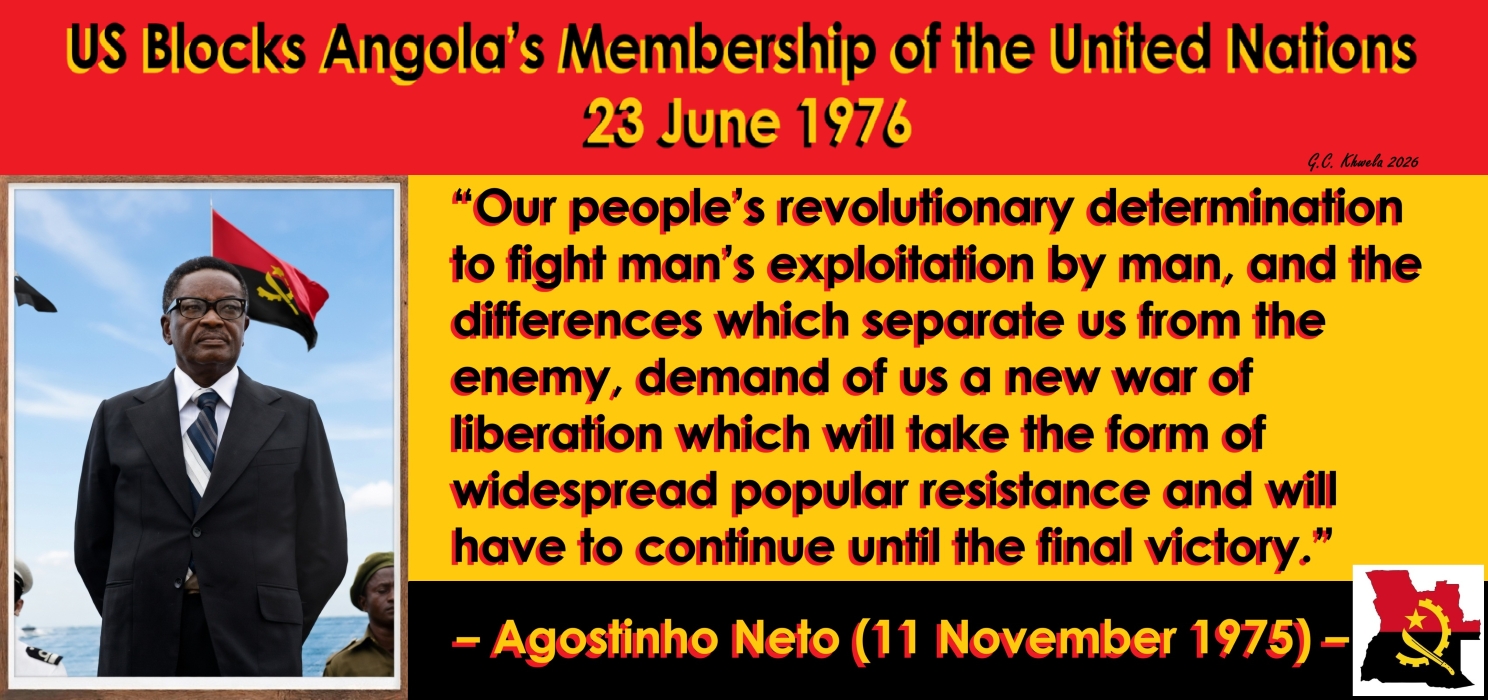
In the words of Angolan President, Agostinho Neto on Independence Day, “Our people’s revolutionary determination to fight man’s exploitation by man, and the differences which separate us from the enemy, demand of us a new war of liberation which will take the form of widespread popular resistance and will have to continue until the final victory.”
Sources:
Wikipedia.
South African History Online (SAHO).
NSC Working Group, “Report Prepared by the Working Group on Angola”, Office of the Historian, Washington, 22 October 1975.
Milestones, “The Angola Crisis 1974–75”, Milestones in the History of U.S. Foreign Relations, Office of the Historian, 1969–1976.
Editorial Notes, “No Neutrality in Angola”, The African Communist, No. 64, First Quarter 1976.
Agostinho Neto, “Victory is Certain”, Vol. 10, First Quarter 1976.
Kathleen Teltsch, “U.S. Vetoes Entry of Angola in U.N.”, The New York Times, 24 June 1976.
Wilfred Burchett, “South Africa’s Road to Defeat”, Vol. 10, Third Quarter 1976.
William Pomeroy, “The ‘New’ U.S. Policy In Africa”, The African Communist, No. 67, Fourth Quarter 1976.
Phineas Malinga, “S.A. Imperialism – The Balance Sheet for 1976”, The African Communist, No. 67, Fourth Quarter 1976.
United Nations General Assembly and Security Council, “Letter dated 27 March 1980 from the Chairman of the Special Committee against Apartheid to the Secretary-General”, United Nations, 1 April 1980.
Peter Kornbluh (Ed.), “Conflicting Missions: Secret Cuban Documents on History of Africa Involvement”, National Security Archive Electronic Briefing Book No. 67, 1 April 2002.
Christopher Saunders, “The South Africa-Angola Talks, 1976-1984: A Little-Known Cold War Thread”, Kronos, Vol. 37, No.1, January 2011.
Ronnie Kasrils, “Cuito Cuanavale, Angola: 25th Anniversary of a Historic African Battle”, Monthly Review, Vol. 64, No.11, April 2013.
Anthony Turton, “Geopolitical Background to the War in Angola 1975 – 1989: An Intelligence Officer’s Strategic Perspective”, Paper Presented at the Second Watercourse History Festival in Plettenberg Bay, 25 February 2021.
Thomas Robb, “The Limits of Covert Action in an Election Year: The CIA, Angola, and the 1976 US Presidential Election”, Diplomacy & Statecraft, Vol. 35, Issue 4, 2024.
Brent Scowcroft, “Memorandum From the President’s Assistant for National Security Affairs (Scowcroft) to President Ford”, Ford Library, Staff Secretary’s Office, Presidential Handwriting File, Box 6, Subject File, Countries, Angola.
Castro Khwela
Good morning fellow Compatriots!🙏🏾✊🏾👊🏾
Discover more from CASTRO KHWELA
Subscribe to get the latest posts sent to your email.